
6
6


Théo Mercier and Romeo Castellucci: top interview with two stage virtuosos
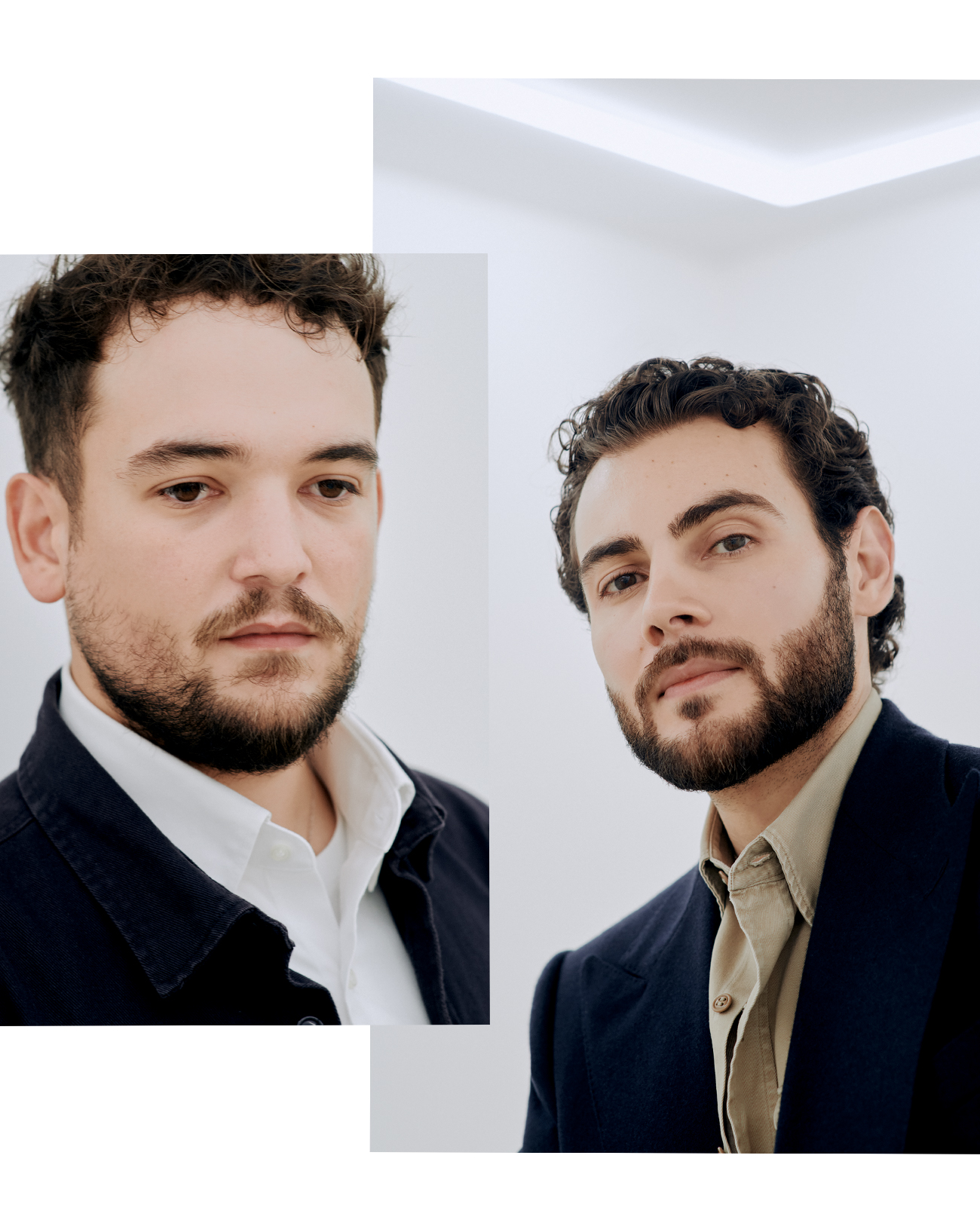
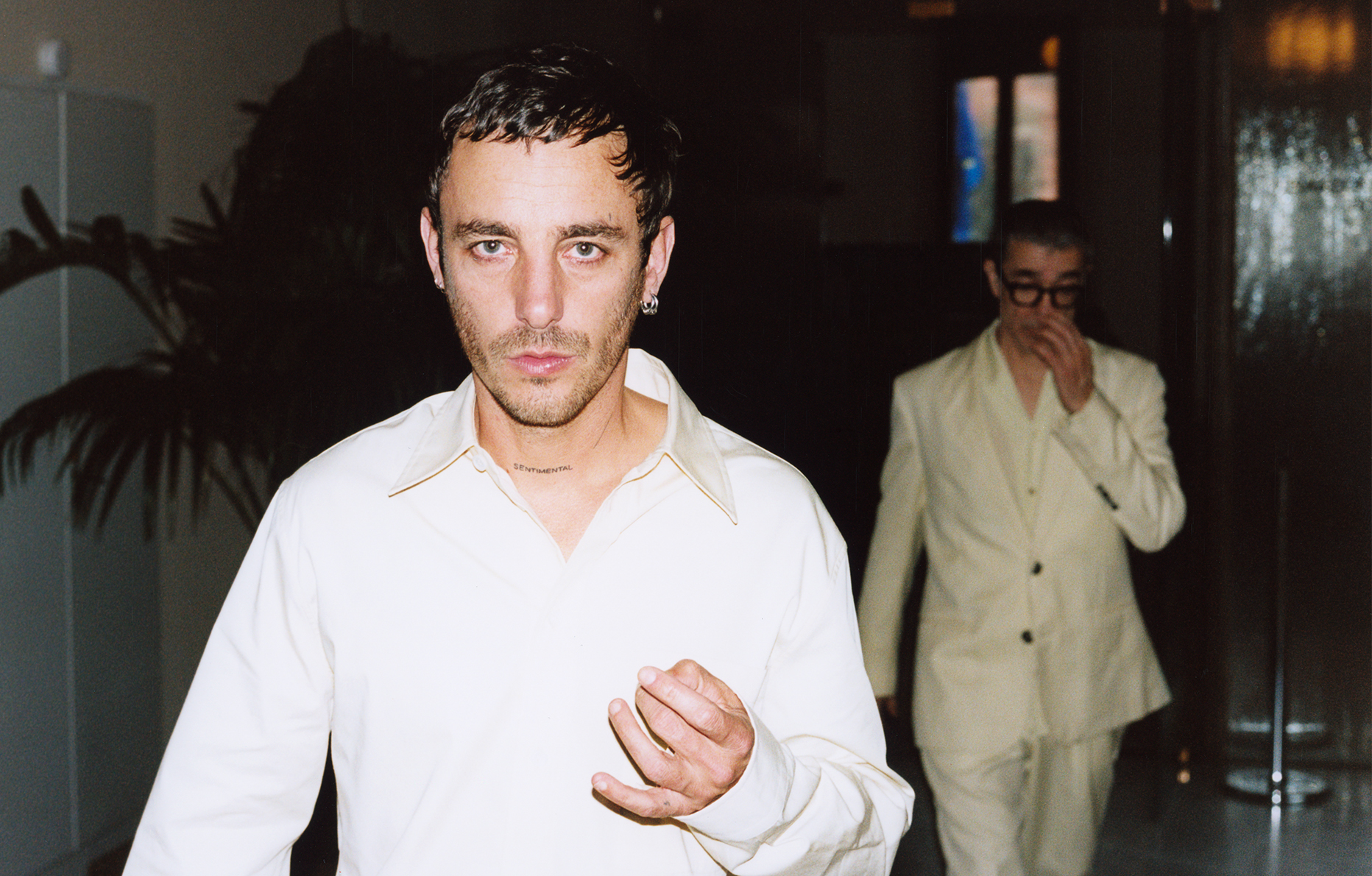
After a spectacular rise as a young French artist, Théo Mercier turned (partly) to theater, putting on exceptional plays whose aesthetics and stagings are breathtaking. A brilliant artist, theater director, and scenographer, Romeo Castellucci has long been one of the most respected – and at times controversial – figures in opera and contemporary creation. Numéro art brought them together in Bologna to discuss how danger and disasters are essential to good dramaturgy.
Portraits by Jonas Unger ,
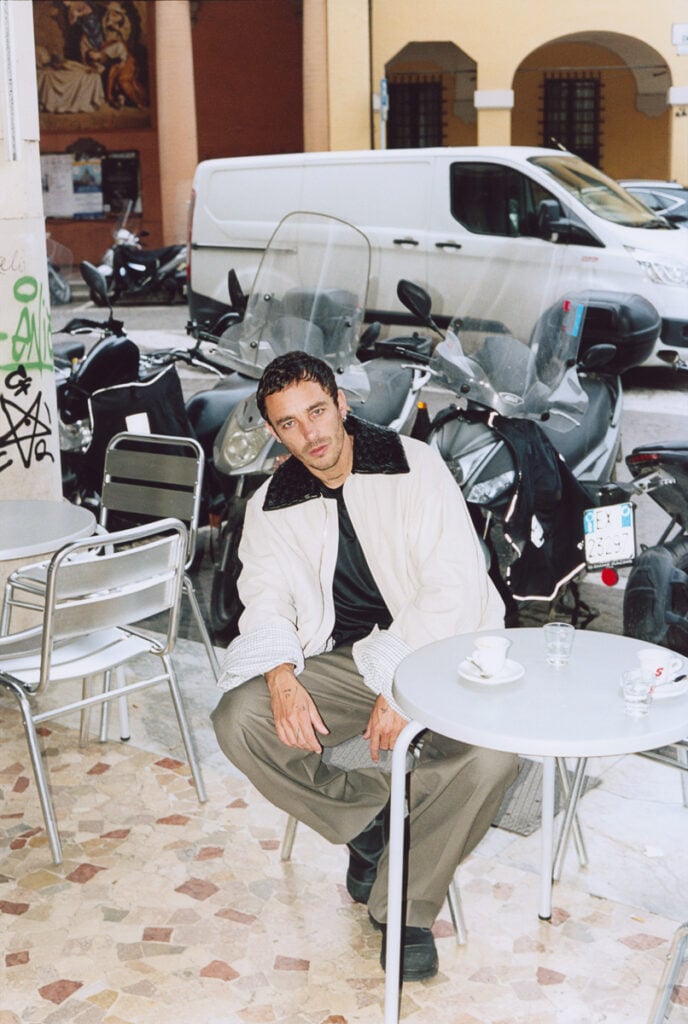
Stylism by Edoardo Caniglia ,
Interview by Thibaut Wychowanok.
Published on 6 June 2025. Updated on 29 July 2025.
Romeo Castellucci: First of all, I must tell you that I remember you as a student. You wrote me letters and we corresponded, right? Théo Mercier: Yes, that was 20 years ago. At the time I was a student in industrial design looking for an internship. I only sent out two applications: one to you and the other to Matthew Barney. I went to New York to work in his studio and didn’t discover your reply until I got back. By then it was too late..
R.C.: It’s interesting that, from the outset, you had an industrial approach, because you’ve always been good at mastering technique and dominating materials.
T.M.: Yes, technique and limitations. I think those are the driving forces behind my work.
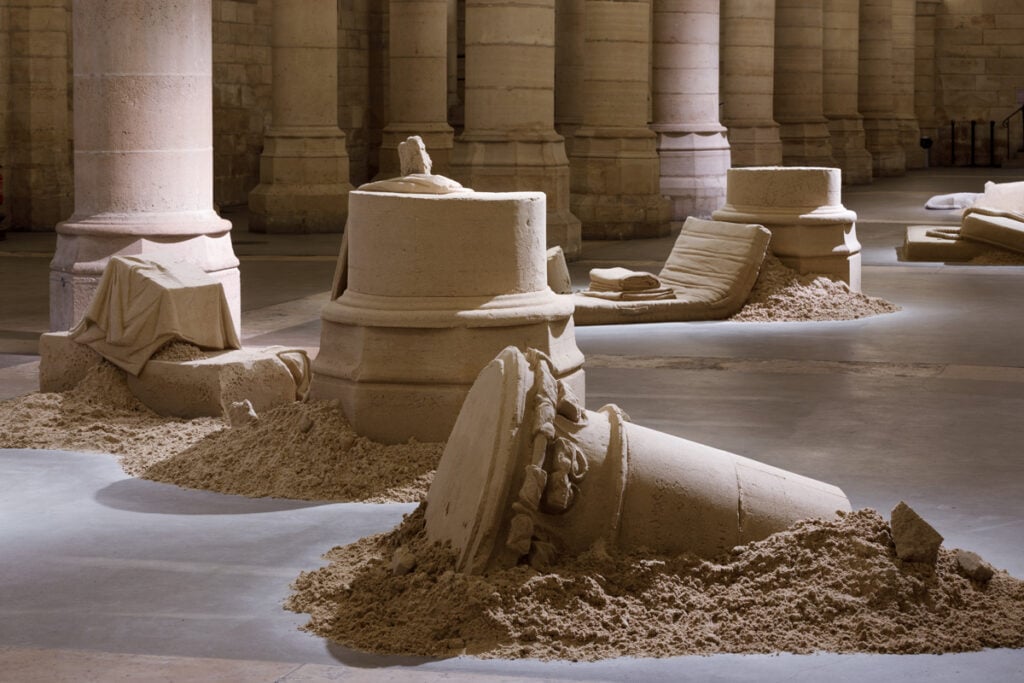
R.C.: You’re always challenging materials. In the end, you use materials that are by definition almost impossible to work with. I’m thinking of sand, of course [used by Mercier in numerous installations, such as at the Conciergerie in Paris, and more recently at MONA in Tasmania].
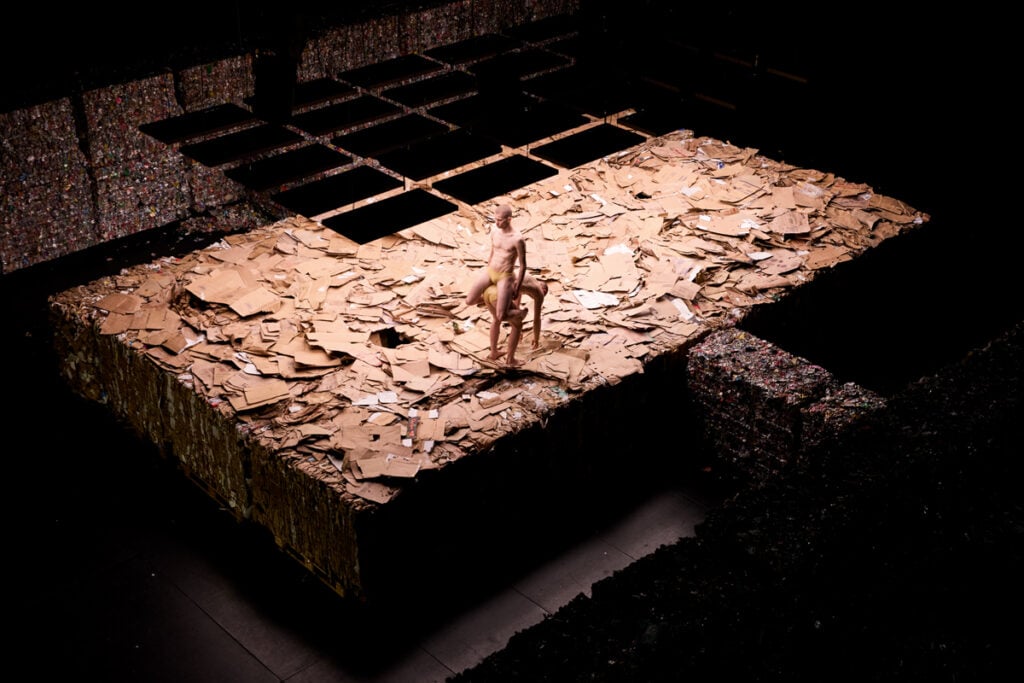
T.M.: Yes, I’m also interested in materials that are impermanent. Sand, for example, or the trash I used for my recent piece Skinless. By their very nature, debris and leftovers are there to be transformed. My projects often begin with matter, and matter is often the main protagonist, because materials and techniques already encompass a large part of the history of humanity.
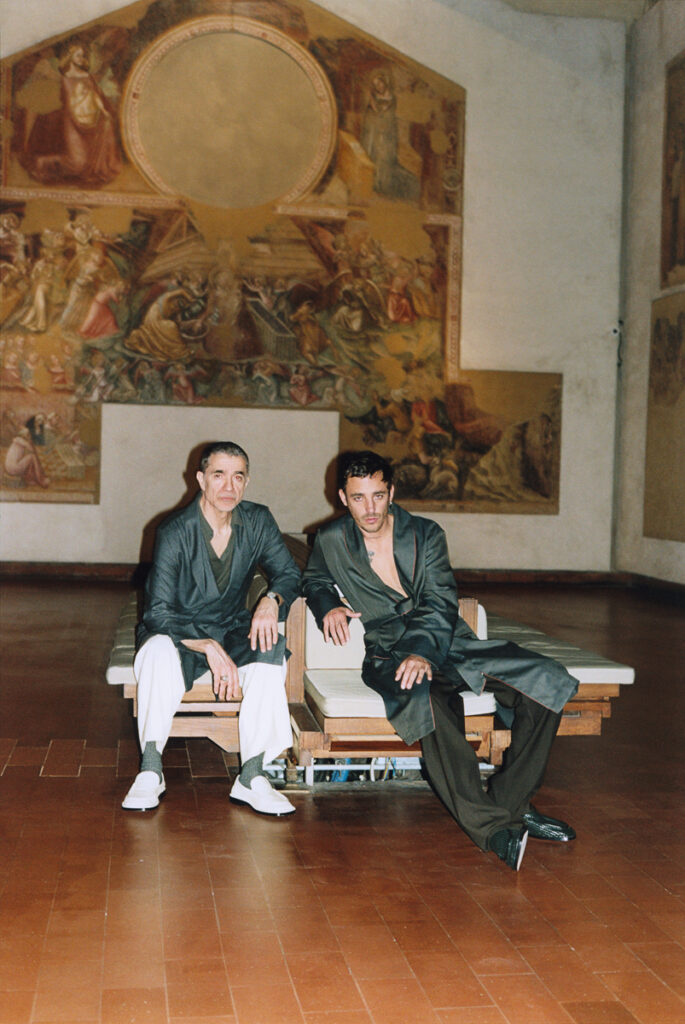
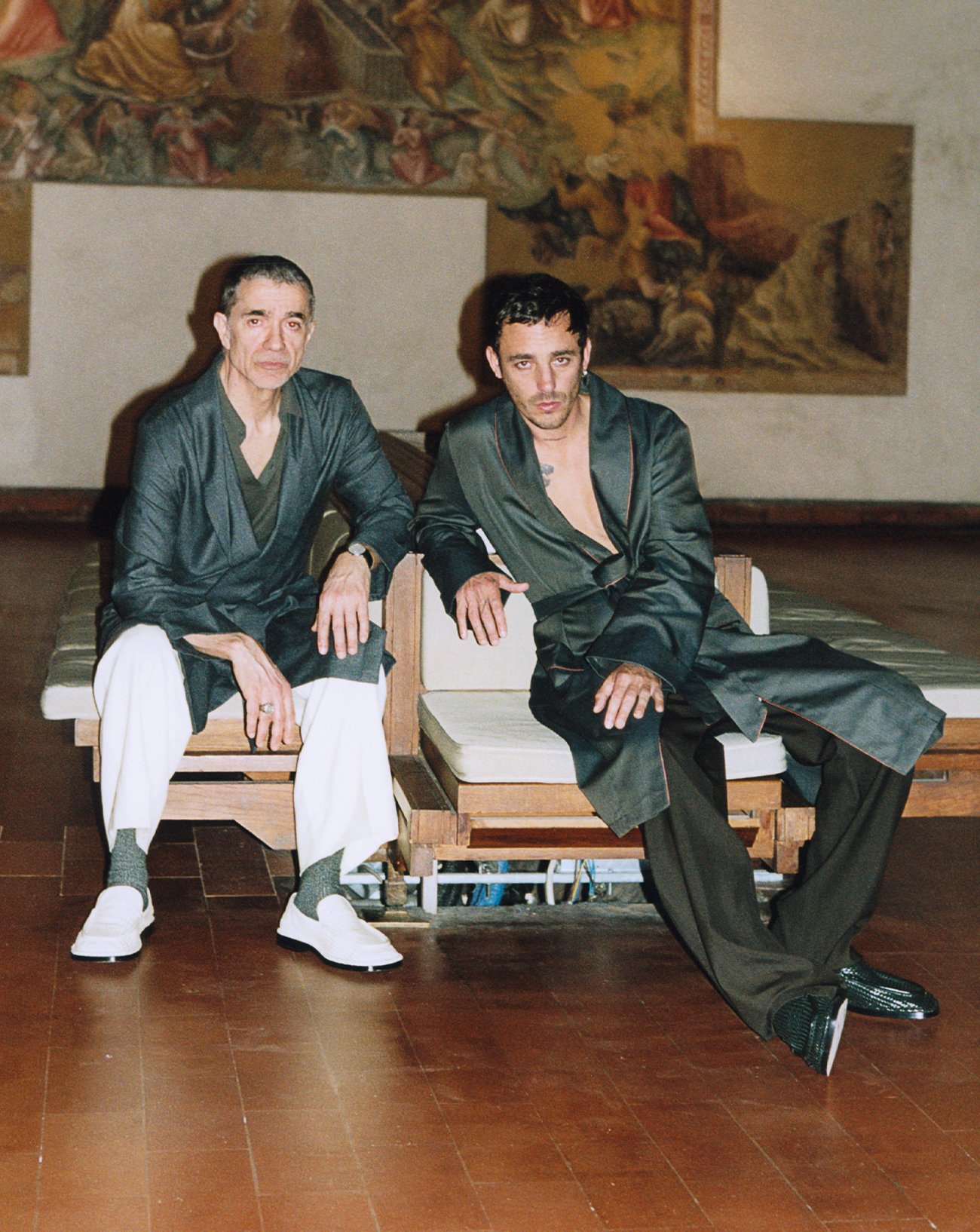
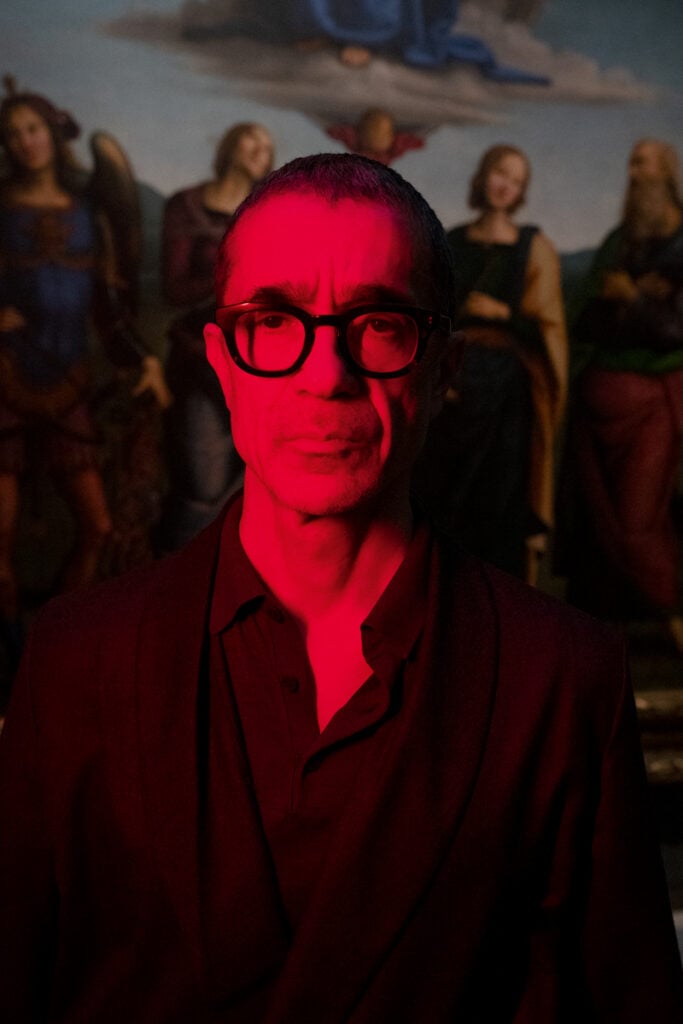
Théo Mercier: dressing gown by Frette, trousers by Magliano, and shoes by Bottega Veneta.
R.C.: And it’s not material for material’s sake either, it’s the journey one can make through materials – even, or rather above all, with the most insignificant of things. The choice of materials is already part of the content of your pieces – there’s already a dramaturgy. Everyone knows the properties of sand, but seeing the way you use it completely changes our relationship to it. It’s the start of a journey. It’s the same with aluminum, cans, cardboard, poles, or household appliances. Materials are the first threshold we cross when we begin a journey. But in my experience, the initial gateway to creation is a word.
T.M.: Yes, you often say that. Where do the words come from?
R.C.: I’m convinced that words choose us. I don’t think I’ve ever chosen words. T.M.: I agree. I often feel more like a vessel than someone who really chooses. It’s as if the outside world is telling me what to do. In your case, when a word or a title chooses you, is it more visual or verbal?
R.C.: It’s more visual. A printed word, because there’s a power to writing. A word that can crush. It’s never nice, never beautiful. I need to be in a relationship of minority to the word. I need to be smaller. I need to be on my knees in this relationship with what happens in the theater. Not kneeling out of devotion, but kneeling before the executioner. Like you, if I’m not mistaken, I need poison, to work with an enemy. Knowhow and professionalism are reassuring. We need to be idiots, but triumphant idiots. Yes, idiots in danger. For our own sake as well the spectator’s, I think. It must be a dangerous space.
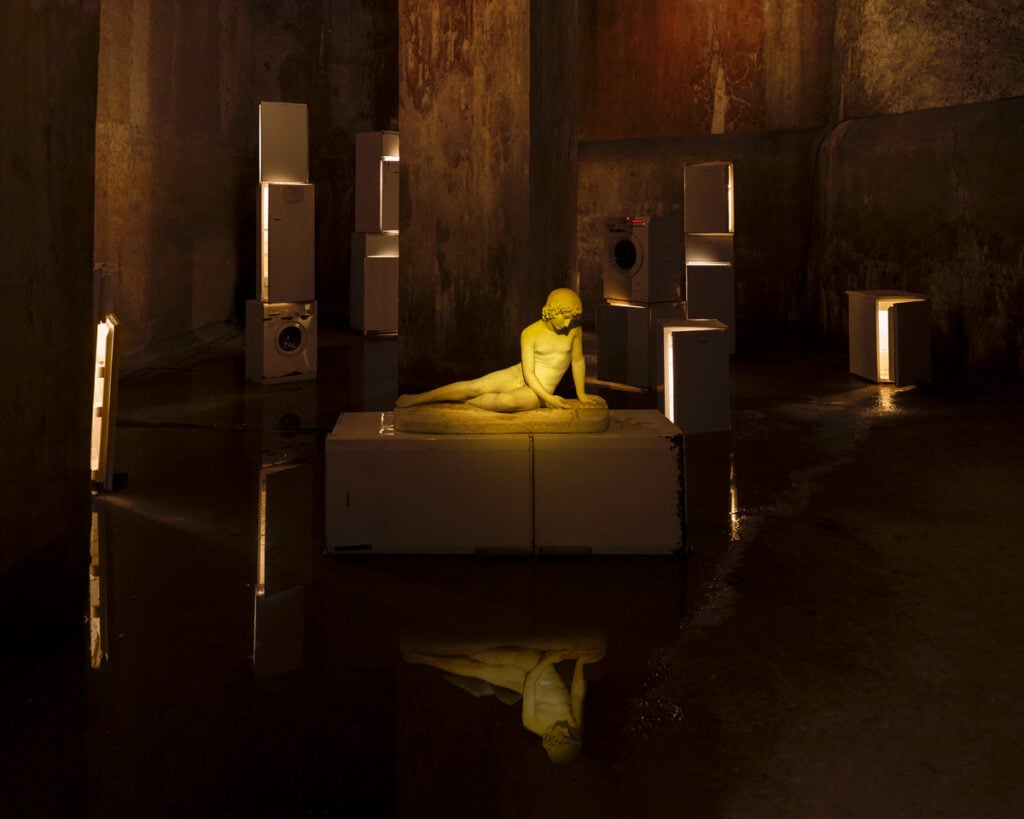
R.C.: The most important question, the one we can’t answer, is: “What is it?” When I go to the theater, to a museum, or to the cinema, or when I read a book, the question is always: “What is it?” If I see an intention start to come through on the part of the artist, then I leave. The answer is never worthy of the question. T.M.: Yes. For me, art should never be an answer. It’s an enigma.
R.C.: Enigma is a very strong word that belongs not only to art but also to the sphinx, to life, to the fact of being born. In an enigma, there’s always a question of life and death. In an enigma, there is almost a hidden logic, a geometry. We don’t know the answer, but we know that there’s an answer. I think a good artist is capable of hiding rather than showing. T.M.: My work is very detailed in advance, but I’m often more interested in the void than in the form, and therefore in absence.
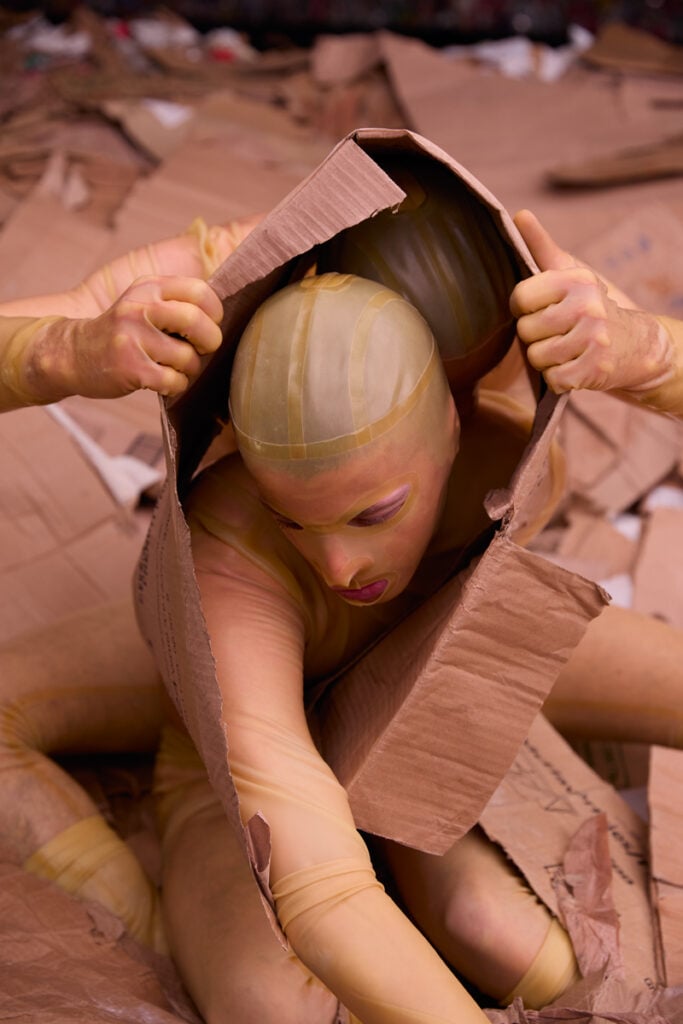
R.C.: In your performance Skinless, for example, which I saw at La Villette in Paris, the form is indeed perfect. Smooth like a tool. But it’s organized around a mystery. We don’t know who these people are. One can only guess, but it’s not clear.
T.M.: Yes, opting for clarity is dangerous.
R.C.: It’s illustrative. Or even worse, pedagogical. I really like the lack of information in your work. But tell me, how do you work in Paris? Do you have a studio? Do you work in sculpture, theater, or installation?
T.M.: I’ve been working in galleries and museums for 20 years and performing for ten. More and more I’m looking for somewhere in between, somewhere between the magic of the black box and the magic of the white cube. Somewhere a little grey. That’s probably why I don’t want the audience to be seated when I perform. When you’re on your feet, on the move, it creates a different relationship with the narrative, a different perspective, like a child looking at insects in the grass.
That’s my mission as an artist: to invent new ways of looking at the world. It’s important for me that the spectators are physically involved and are in charge of their bodies and immediate surroundings. How do you stand? Do you touch the material or not? I’m very interested in placing the audience in a certain discomfort, because it allows me to defy a comfortable perspective and to work from a position of fragility that may engender new outlooks.
“What I was looking for with Skinless was a place of reconciliation with the world’s brutality.” – Théo Mercier
In the piece I performed at La Villette, the public was in the presence of 100 tons of trash. This intense proximity to dirty matter, to its stink, to what’s going on between the characters can seem quite violent and brutal. Yet what I was looking for with Skinless was a place of reconciliation with the world’s brutality, the landscape, and its forms of separation. Waste is what remains after something is consumed, dropped, no longer wanted – it’s a story of separation.
I wanted to create a story that could intensify or defy the separation between humans and their environment, between humans and their waste. And the romantic breakup that plays out between the two performers also embodies the way in which we reconcile with everything we’ve broken, everything we’ve cut, everything we’ve thrown away, everything we’ve swept under the carpet.
R.C.: So what are your feelings about disaster? T.M.: Disasters are always a transitory process. There’s a before and after the disaster. Disaster, ruin, and collapse are very present in my imaginary and in my work. They exist at their most romantic, but I also see them as something that puts life in the balance and allows us to reinvent ourselves. When you work with sand, for example, images of catastrophes always come to mind. We excavate the seabed, we hollow out mountains, which then disappear, in order to supply the material to build cities. They are the result of very brutal metamorphoses and transformations. Of danger too. It’s somewhere unknown…
R.C.: And those disasters are linked to the twilight of our times and to the West – as I’m sure you already know, etymologically “occident” means “to fall.” T.M.: Yes, it’s a Western disaster.
R.C.: In your performances, I have the feeling that something has been consumed, destroyed, exhausted, but in its ashes there remains a ghost. Your work is about destruction, but something happens again. Another question comes to mind: what is your relationship with phantoms, with dead material, be it household appliances, cars, sand, or cans? T.M.: I work with familiar things, things from everyday life, but I look for strangeness in them. I look for a kind of upending of the world, the world we know, but which is suddenly seen from below.
“In this way, I try to give a second chance to the world, to the things that are there, to what exists, even if the place from which I speak is one of terrible despair.” – Théo Mercier
R.C.: I see it as a radical way for you to contest the principle of reality… The theater and exhibitions are never just about presenting an object as it is, are they? A dramaturgy comes into play, the object is placed in relation to the space and to other things, and yet the object somehow escapes. T.M.: For me, it’s also a place in which reality can be re-enchanted. In this way, I try to give a second chance to the world, to to the things that are there, to what exists, even if the place from which I speak is one of terrible despair – our cities, our cars, our trash… The poetry of encounters or the upending of things and of forms in my work also evoke hope for me.
R.C.: That makes think of a theological paradigm: “apocatastasis,” or the final restoration of all things to their original state. We start over… T.M.: Yes, if we could start over again, we would. I don’t feel any pessimism, guilt, or irony – those are my true enemies. But this rebirth, or shall we say this other possibility, only occurs thanks to disaster.
R.C.: It’s like being haunted every night by a dream, except that I’m really afraid of dreaming, because I’m terrified of remembering my dreams. But on the other hand, dreams often haunt me. Ideas come at night, even if it’s daylight outside. T.M.: And how do you move on from this encounter, from a word, to the image and the environment?
R.C.: The word is the threshold to dramaturgy, and dramaturgy is the path toward the image. Then comes the combat with reality – showing something in spite of that thing. Then I work on the form, and after that I go into the rehearsal space with this outline and discuss it, with some embarrassment I must say, with my collaborators. T.M.: For me, mental images come in great detail, in the street for example. And an image gives rise to a lot of words, texts, like a constellation. I’m on the same wavelength as you there. When I’m doing research, I try to create opportunities for openness and permeability in my everyday life. It’s as though things will traverse me. Walking helps me achieve this, in the street in particular, or in places where I feel vulnerable. It’s as if I’m waiting for an illness, waiting to be infected. These are moments of reflection when I expose myself.
R.C.: Words are poisoned tools for conjuring up images. T.M.: And I often accompany them with drawings. Together they form the melody of the project… The link between two words, such as LOVE and WASTE, and the electricity that that produces.
R.C.: Disasters force us to reconfigure how we see things, to rethink the world, to “make space.” And that can be welcome news. We can invent a new relationship to things and to the world. Only a politics of disaster can save us. T.M.: And what about you, how do you work? Where do you find ideas, images, and words?
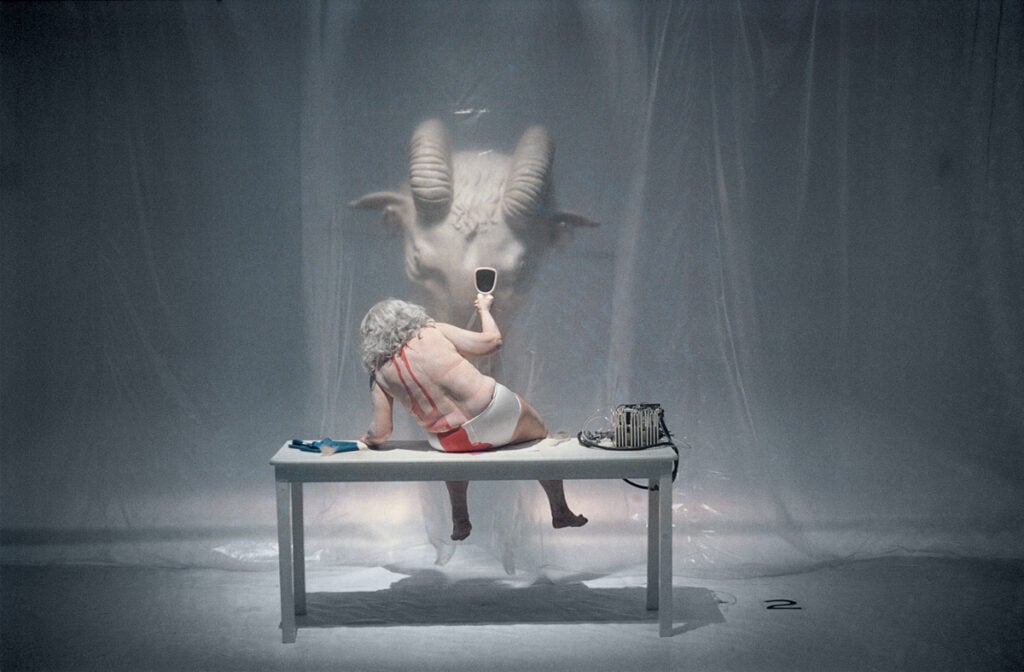
R.C.: I’d like to discuss another aspect of your work, the mythological gaze you cast on banality. The banality, for example, of IKEA furniture [in the play Affordable Solutions for Better Living, 2018, co-created with Steven Michel]. T.M.: For me, these are the objects of a sad reality with no future. They kill the world, the home, the planet. They are often the result of horrible working conditions. They make interiors ugly and offer us standardized lives, Imaginaries in kit form. There’s nothing good in any of it.
R.C.: But this banality is transfigured in your work: an object becomes a character who comes unexpectedly on stage. T.M.: Yes, the character in this play – who is an alpha male in the image of the world’s best-selling and most efficient IKEA bookshelf – will gradually shed his skin in the manner of a flayed man and move on to a deeper level of his desires and his story… We transfigured this violent banality, because what else are you going to do with all that? What do you do with violence, ugliness, sadness, old age? What do you do with everything that hurts?
R.C.: On the one hand, violence is part of the history of religion and of art. But that doesn’t mean we should defend it, or that we should deny it. I believe that the laboratory of violence in the context of art helps prevent violence in real life. On the other hand, we can’t pretend that violence doesn’t exist in our world. Violence does indeed exist and must be seen, treated, and transfigured.
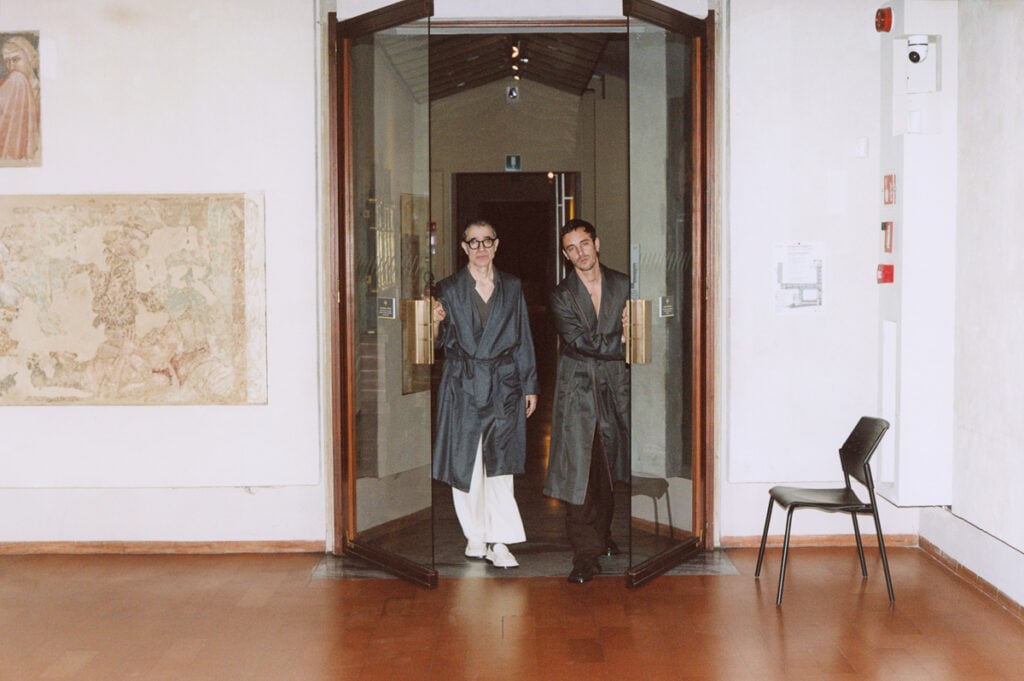
Théo Mercier wears a robe by Frette, trousers by Magliano, and shoes by Bottega Veneta.
T.M.: What do you do with violence in Bros, for example [a play featuring around 30 actors dressed as police officers that questions our relationship with the law and domination]? R.C.: It’s very literal, I must say. I wanted to own the poison, to look Medusa in the eyes, to look at the face of violence, which is not only outside us. I wanted to own our violence and drink the chalice to the dregs… The Iliad is a book of beauty and violence in their pure state. In Bros, there was the paradoxical relationship to the law – the police as representatives of the law – but there’s something tenebrous in the law and in its heart of darkness. Disaster, with you for example, is a way of sticking your head in the filth. You come out stained, but you gain a conscience. And having a conscience means a lot to me.
T.M.: How do you see our responsibility as artists? R.C.: I don’t think artists are better people. The images we carry inside us are not mandatory. They aren’t media images that impose themselves on people’s screens – the new fascism of information. In an artistic context, you have the possibility to look at things differently, with a profound sense of the gaze. Your gaze that gazes back at you.
T.M.: There’s an economy of vision, of course. What is a gaze that wanders down a screen compared to an advertising gaze, a gaze in the theater, at the zoo, at school, or in a museum? How does it work, in what timeframe, and in what context does all this guide our perceptions of the world? As a theater director, I sometimes have the feeling that I’m subverting the same tools that the media, industrialists, and institutions use, but in favor of stories that can touch us… R.C.: Touch, anger, hurt, or penetrate us. And you can refuse it. Your body speaks. You can stop an image if you want. Then the moment comes to take a stand: is it right for me to look at this or not? The artist is not there to assert a message like a pedagogue, but to slow down the advent of the signified.
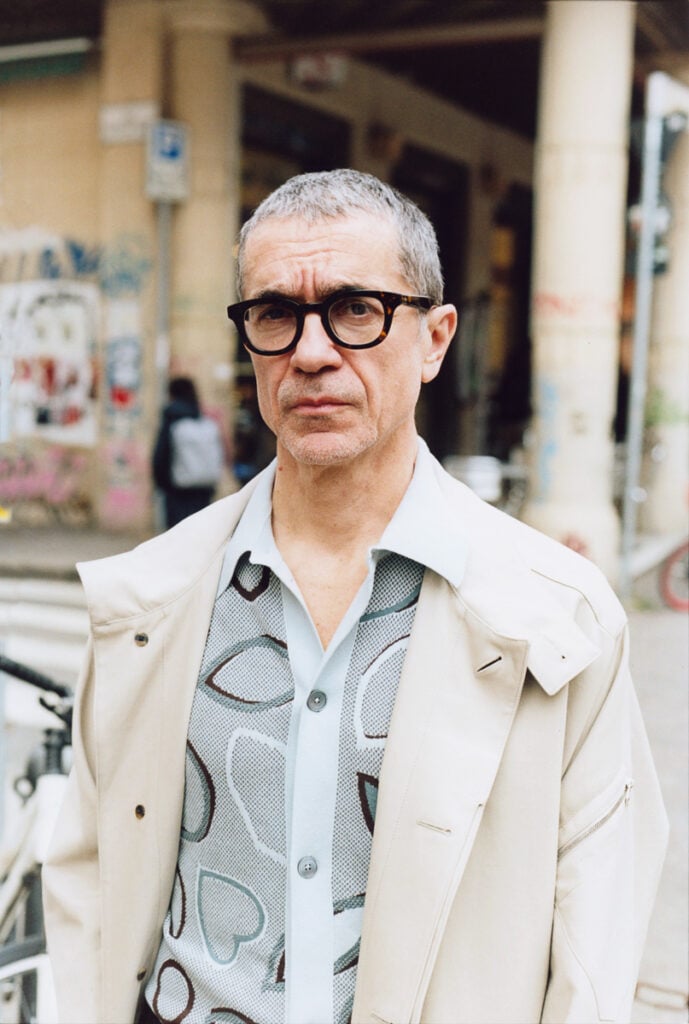
Skinless by Théo Mercier, on tour throughout France.
Radio Vinci Park by Théo Mercier, from October 16th to 26th, 2025, as part of the Festival d’Automne in Paris.
Solo exhibition by Théo Mercier, from September 6th to October 5th, 2025, at the Mor Charpentier gallery, Paris.