8
8


The scandalous and controversial art of Philip Guston
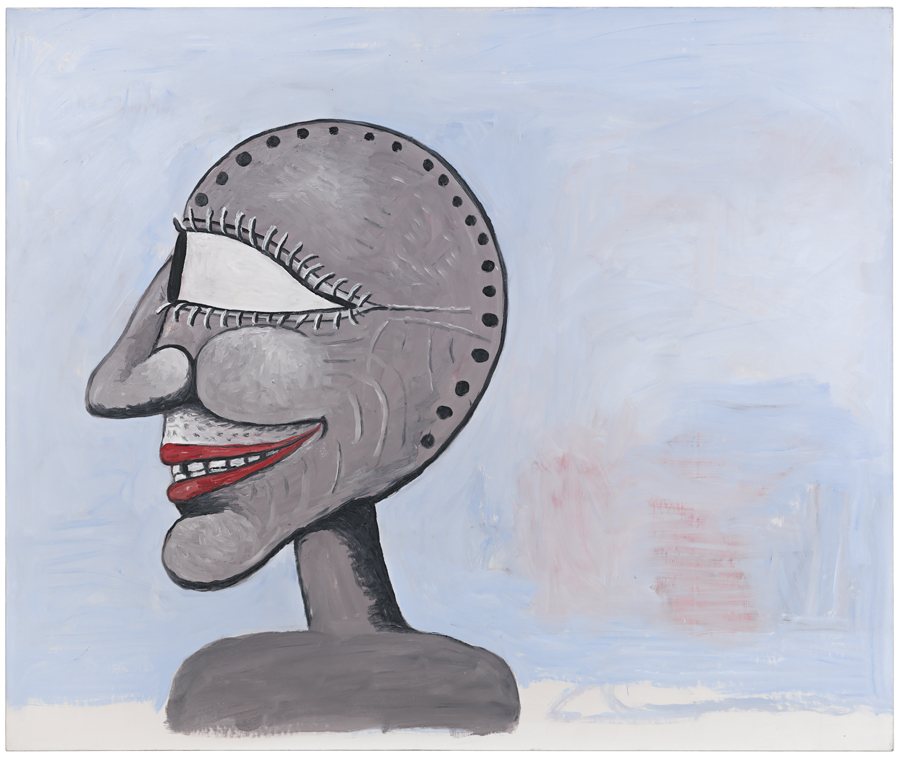
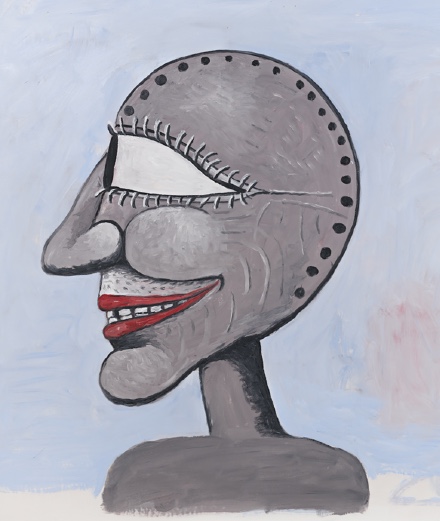
Over the course of his career, Philip Guston has never ceased experimenting, going from figurative to abstract painting. The American artist’s work has been shown in all the most prestigious museums around the globe. Throwback to his major retrospective at the Musée Picasso-Paris in 2026, where his Nixon Drawings and Action Paintings were on show.
By Éric Troncy.
Published on 23 November 2020. Updated on 8 July 2026.
Philip Guston’s huge art legacy
He is one of the greatest American painters of the 20th century. His work largely influenced painters of the 21st century, from Brian Calvin to Joe Bradley, who claimed his legacy. During his 50-year career, Philip Guston was in turn a realist painter, an abstract painter and a figurative painter. His talent was hailed in whatever style he chose to experiment with. An explorer and researcher looking for form and trying out styles, Philip Guston was a true pioneer.
Like all avant-garde artists from that era that now seems so distant, his creativity was boundless. “The act of painting is like a trial in which all the roles are played by the same person,” the American artist once declared. “The canvas is the courthouse while the artist is the prosecutor, defense attorney, judge and jury.” Exactly 40 years after his death in 1980, large retrospectives around the US and UK took place in 2024. When the art world gets caught in its own trap, the very idea of art collapses.
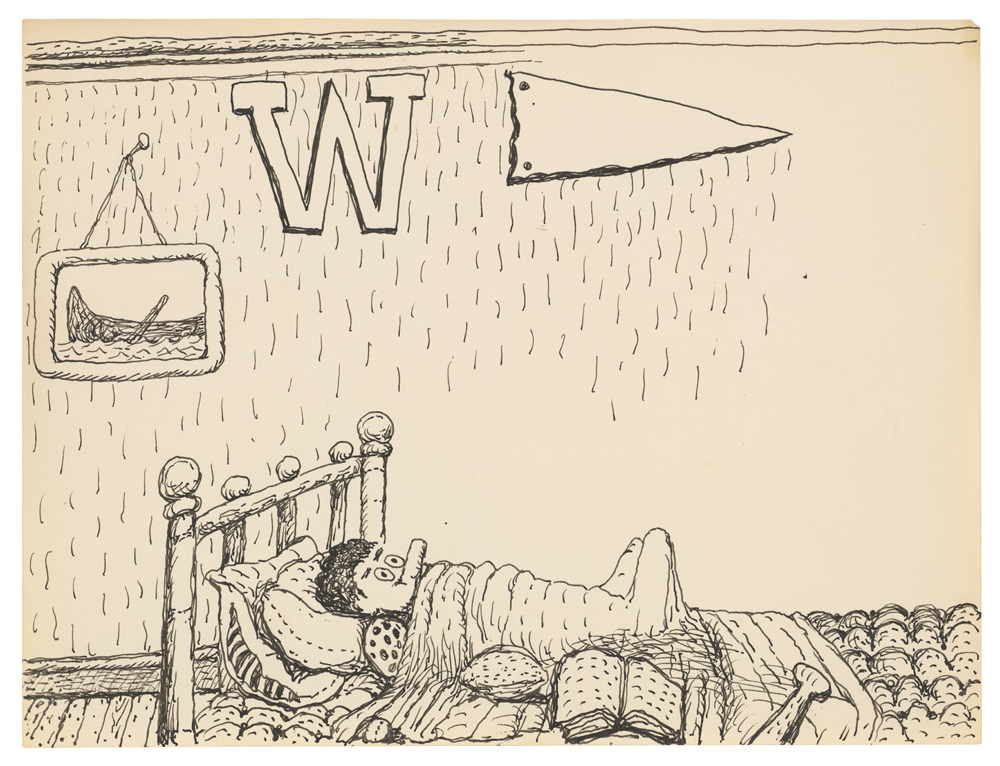
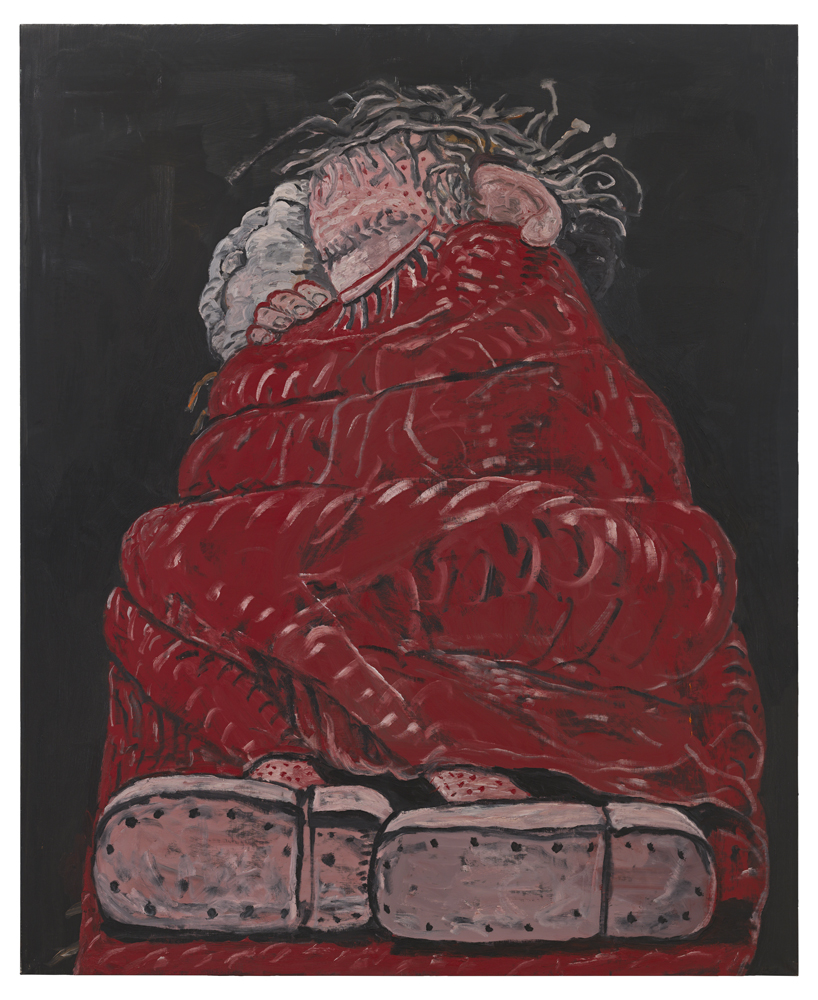
The Whitney and MoMA in New York, the Chicago Art Institute, museums in Denver, Houston, LA, Memphis, San Francisco and Washington, the Centre Pompidou in Paris — repository of the splendid work In Bed (1971) — the Tate Modern in London, the National Gallery of Victoria in Melbourne, Louisiana Museum in Copenhagen, Ludwig Museum in Cologne and the Tel-Aviv Museum of Art… All these prestigious institutions were lucky enough to exhibit Philip Guston‘s works. One might almost say it was their duty to own them, if they wanted to offer a genuine overview of 20th-century art.
A childhood marked by trauma
Born Phillip Goldstein in 1913 in Montreal to Ukrainian Jewish parents who fled the city of Odesa to first settle in Canada in 1905, then in Los Angeles in 1919, the artist got traumatized at a young age? He was 10 when he discovered the swinging corpse of his father, who committed suicide, in the garden shed. Philip Guston spent much of his childhood hidden in a closet, copying cartoons from the daily papers.
“As a child, I would hide in a closet while my older brothers and sisters came with their families to dine on Sunday evenings. I felt safe there. Listening to them talk about their health, marriage and financial problems, I felt how much I was distant from their world in my closet, lit by a single bulb. I read and drew in this box that was mine. On Sundays, I would even paint in that closet,” he shared.
A prolific friendship with Jackson Pollock
At the Manual Arts High School in Los Angeles, where he enrolled in 1927, Philip Guston became friends with one of his classmates, Jackson Pollock. The following year, the two artists got expelled for publishing a fanzine which, among other things, criticized the omnipresence of sport at that school. Together they moved to New York in 1930, where they shared an apartment. Like Pollock in the 1930s, Guston’s painting was at first figurative, before being influenced by Picasso and the Surrealists. His work became increasingly abstract and influenced by Cubism up to 1948.
“I had the feeling I’d finished that exploration,” he explained later. “The following year, I destroyed everything I’d done. I felt that everything was a failure and that I could no longer continue with figuration. The forms I wanted to paint could no longer take the form of objects and beings, and I felt I would have to abandon the figurative. It was a long struggle to get there. I felt torn between two allegiances, one to my own past and another to what I could still become,” he added.
Red stacks of painting for a unique figurative style
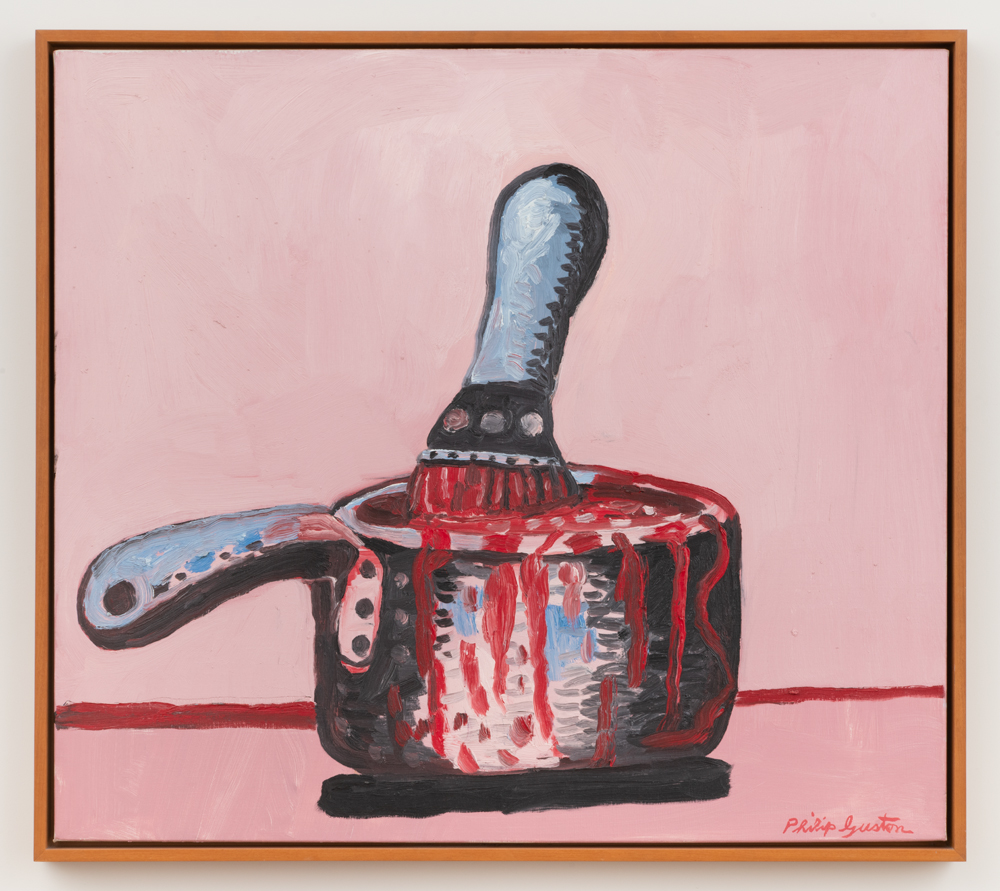
Philip Guston’s canvas Red Painting (1950) is almost a monochrome. Red would eventually become his main colour, if not the only one, in his subsequent body of work. In the 1950s, he was one of the most talented exponents of Abstract Expressionism, alongside Willem De Kooning, Jackson Pollock, Mark Rothko, Barnett Newman, Franz Kline. However, the Canadian painter soon became frustrated with abstract painting. “At the beginning of the 1060s, I felt completely torn, almost schizophrenic because of war, of what was happening in America and of the brutality of this world. What sort of man was I to stay home reading magazines, furiously angry about everything, and then go to my studio to add a bit of red to some blue… I said to myself that there had to be a way to act.”
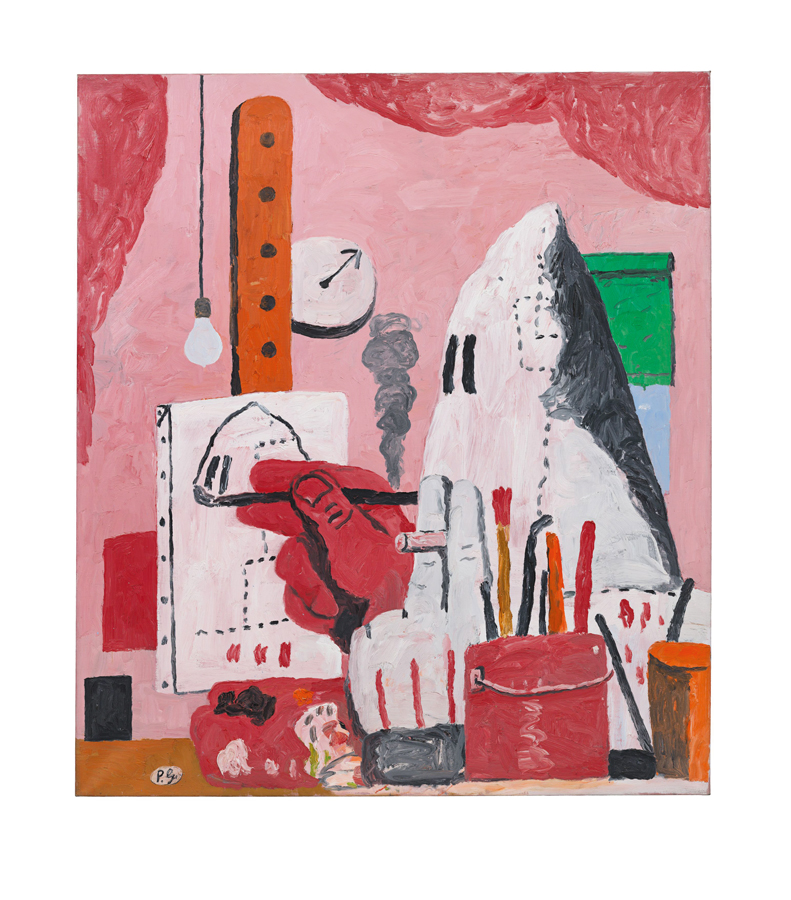
His singular, innovative figurative style seemed to preserve something of the cartoon strips he used to copy as a child in the closet where he sought refuge. One might even say that the impertinence of this new aesthetic, in particular the inspiration from cartoon strips, caused a scandal. Philip Guston was thrown out by the Marlborough Gallery in New York after showing his art there.
A new creative vocabulary
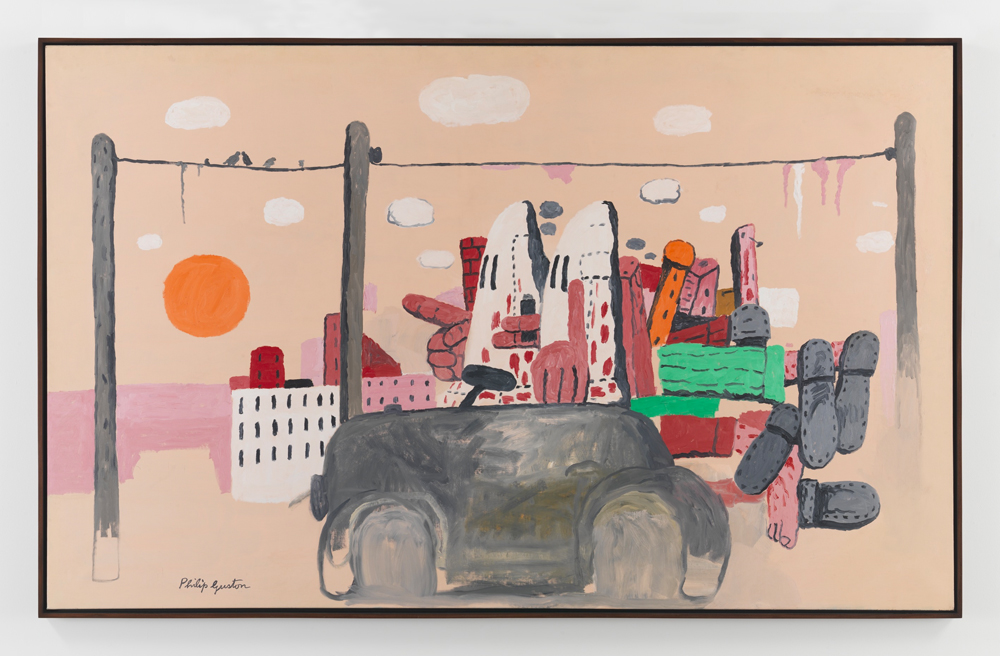
He repetitively painted objects — shoes, hands, cigarettes, clocks, cars or pointy hoods — resembling those worn by the Ku Klux Klan. In fact, Philip Guston had already represented the violently racist, anti-Semitic white supremacists of the Klan in the early 1930s. For instance, Drawing for Conspirators (1930), which is held in the collections at the Whitney. That theme would eventually become a recurring one in his work, a symbol of oppression and violence towards African Americans in particular. With their fat cigars and show-off gas-guzzling cars, his KKK characters appear completely repulsive.
In one fell swoop, not only did Guston invent a new artistic vocabulary, but he also produced a socially conscious form of painting that echoed the world’s darkest aspects. The initially negative reaction slowly gave way to unequivocal recognition, especially among fellow artists, and his market values duly followed. In May 2013, his canvas To Fellini (1958) sold at Christie’s for almost $26 million, double its upper estimate.
The late recognition of Philip Guston’s work
Forty years after Philip Guston’s death from a heart attack, the art world has new priorities. Since the turn of the millennium, contemporary art has been more accessible. In doing so, it has attracted a new, less elite perspective and works are being appreciated not so much for their contribution to art history than for what they have to say. A fresh viewpoint that seems to forget that art is not some sort of primal communications form akin to advertising.
We are living at a time when art is expected to dish out clear, unequivocal messages. Those messages are often rather explicit and tediously banal. War is bad, inequality is awful, etc… And woe betide all those who would seek to put a little complexity into this black-and-white, simplistic approach. Four decades after he left the land of the living, Philip Guston has paid the price for this spectacular deterioration in the way we look at art.
Nine years ago, the National Gallery of Art in Washington, the Museum of Fine Arts in Boston, the Museum of Fine Arts in Houston and Tate Modern in London decided to dedicate a large retrospective to the art pioneer’s work. Those tempted to find the absence of the Centre Pompidou regrettable would do well to remember that a huge retrospective, which travelled to Boston, Stuttgart and Ottawa, was shown there in 2000, curated by Didier Ottinger.
From a postponed retrospective to a major exhibition at Musée Picasso-Paris
On September 21st, 2020, a joint press statement cut the anticipation short. “After a great deal of reflection and extensive exchange, our four institutions have jointly made the decision to postpone the Philip Guston Now exhibition. It will be presented later, when the powerful message of social and racial justice at the centre of Philip Guston’s work can be more clearly understood […]. We’re planning on presenting a reviewed exhibition in 2024.” The indignation was loud, denouncing quite rightly the insult to visitors, who, one can only deduce, were deemed unable to understand that a representation does not indicate unequivocal agreement with the element in question. Especially when the artist’s intention to denounce something is quite obvious.
With Guernica, for example, Picasso does not plead the case of war but, on the contrary, seeks to depict the horror of it. Yet, it probably wasn’t ordinary gallery-goers that the four museums were afraid of. It was more likely the potential reactions of the “cancel culture” police that they feared. The opinion that currently writes, and above all rewrites history, deciding what is and what isn’t “degenerate art.”
“Philip Guston. L’ironie de l’histoire” (2026) at Musée Picasso, 5 Rue de Thorigny, Paris, 3rd arrondissement.
Traduction Emma Naroumbo Armaing.