5
5


5 spectacular runway shows that marked fashion history
The latest fashion weeks have been an opportunity to witness myriads of breathtaking shows. Among them, a theatrical performance at the Palais de Chaillot by Maison Margiela Artisanal, a catwalk on the steps of the Piazza di Spagna in Rome by Valentino, the release of fireballs at the Palais de Tokyo by Rick Owens… These sensational presentations took both audiences and social media by storm.
Published on 5 September 2022. Updated on 28 July 2025.
Presenting a collection did not always involve creating a spectacular show. In the first half of the 20th century, couture creations were presented on models to a handful of valued clients and journalists in the intimacy of small private rooms. From time to time, fashion designers would venture beyond these plush padded spaces to explore other venues. For instance, Paul Poiret ventured into the world of theatre and created the costumes for the play Le Minaret in 1913. Gabrielle Chanel also created the silhouettes for the Russian ballet Le Train Bleu in 1924.
In the late 1960s, the advent of ready-to-wear and the popularisation of fashion reshaped the meaning and format of fashion shows. The role of designers evolved too. New names like Thierry Mugler or Jean-Paul Gaultier stood out. Far from the stiff rituals of haute couture presentations, ready-to-wear opened up a wealth of possibilities. Fashion designers became stage directors, transforming the catwalk into short shows used to convey their creative vision. From Alexander McQueen to Martin Margiela and Yves Saint Laurent, here are five fashion runway shows that have revolutionised the history of fashion.
1. Thierry Mugler’s Fall/Winter 1984-1985 and Fall/Winter 1995-1996 shows
Thierry Mugler was the first and probably the best fashion entertainer. In 1984, he left a lasting impression on his audience creating an anniversary show of unprecedented scale, ten years after the creation of his house. Hosted at the Zenith concert hall in Paris, the show took place on a 35-metre catwalk and was open to the public for the first time. It then inspired other labels, such as Marine Serre for her Spring/Summer 2023 show in June 2022 or Diesel‘s show in September 2022, to do the same. The event was memorable – 6,000 spectators bought their tickets to attend the show.
In an exceptional turn of events, Thierry Mugler coordinated everything himself, from the lighting to the set, including the 250 outfits that were presented to a soundtrack of hits. To celebrate the 20th anniversary of his house, the designer repeated the experience, but this time at the Cirque d’Hiver. Once again, he oversaw all the details of the wild show broadcast live on the local TV network Paris Première. This was unheard of for a fashion show, but it would later become a habit. To the tune of Bobby Byrd and James Brown’s Sex Machine, supermodels Naomi Campbell, Jerry Hall, Claudia Schiffer and Kate Moss wore his most iconic creations, confirming his boundless genius. As a backdrop, he designed a spectacular stage with a huge star at its centre, as a reference to the heady Angel fragrance.
Cult looks have made history, like the metal and Plexiglas jumpsuit designed with the artist Jean-Jacques Urcun. This piece made the front page of the most prestigious fashion magazines. Besides, his velvet and satin dress inspired by the painting The Birth of Venus by the Renaissance painter Botticelli was worn by Cardi B at the 2019 Grammy Awards… A real fashion statement, whose lasting impact was showcased in an exhibition dedicated to the creator at the Musée des Arts Décoratifs in 2022. While Thierry Manfred Mugler sadly passed away, the glamorous extravagance of his house lives on. The brilliant American designer Casey Cadwallader, who joined the house in 2017, followed in the late designer’s footsteps, as shown in his jaw-dropping Spring/Summer 2022 musical show.
2. Martin Margiela’s debut Spring/Summer 1989 show
By the end of October 1988, the fashion world was restless. In the small Parisian cabaret Café de la Gare, 300 people were sitting on rough wooden benches, including Jean-Paul Gaultier, waiting for Belgian designer Martin Margiela‘s debut show, who had just graduated from the Royal Academy of Fine Arts in Antwerp, Belgium. The invitation was a simple newspaper page sent out ten days prior to the show. All the information about the show were circled in red, lost among other ads. Inside the theatre, the set was quite simple as well. Large white canvases on the floor served as a catwalk, welcoming a sequence of 52 looks worn by models walking among the guests to a playlist featuring the Rolling Stones, Iggy Pop and The Velvet Underground.
Dipped in fresh paint, the models’ feet painted the catwalk red. Some were barefoot, while others wore the famous Tabis, which the designer introduced during his first runway show before he commercialised them in 1992. Designed as an “invisible” shoe, the boot, whose form separates the big toe from the rest of the foot, must give the illusion of a bare foot balanced on a heel. At least that is what the traces on the floor – used as a pattern for the following show – suggest. The models’ faces were completely anonymous, hidden behind veils, even though that decade had witnessed the birth of the first supermodels. In 1998, he even had hangers appear instead of models.
With his nonconformist approach to fashion, Martin Margiela transformed the classic presentation into an artistic happening, which, moreover, showcased the cornerstones of his practice: the colour white, underground venues, nudity treated like a material… For this collection, the house had only seven clients, of whom only two were delivered due to production issues. Beyond its purely commercial ambition, this show laid the foundations of the designer’s world and was nevertheless a media sensation, so much so that the following invitations were snapped up, both for their originality and their symbolic value. A frenzy that the designer would continue to feed by organising his next show a year later in an abandoned garden in the 20th arrondissement of Paris, with, for invitations, drawings coloured in felt pens by children… The Margiela legend was born. A subversive universe whose boldness was on full display during the Maison Margiela Artisanal show under the Alexander III Bridge in Paris.
3. The Versace Fall/Winter 1999-2000 show
While Martin Margiela hid the faces of his models, Gianni Versace chose to make them the highlights of his shows. In particular for his Fall/Winter 1991-1992 collection, which was a must-see as it ushered in the flamboyant era of supermodels. While for several months George Michael‘s hit Freedom! ’90 had been taking the airwaves by storm, the Italian designer chose it as the soundtrack of his presentation. But he didn’t just borrow the catchy tune from the singer… The video for the song, released in October 1990, featured five models who were famous for their magazine covers but appeared seldom in fashion shows: Naomi Campbell, Linda Evangelista, Tatjana Patitz, Christy Turlington and Cindy Crawford. It was then that Gianni Versace, inspired by his sister Donatella, decided to invite them on his catwalk. Early 1991, the models set the catwalk ablaze and it has since become a cult show. Fiendishly sexy, they wore Versace’s tight, colourful designs for the finale, holding hands, lip-synching the lyrics to Freedom! ’90. The audience was galvanised: the supermodels were born, who would go on to land the biggest contracts for the following decades while walking the catwalks of the most prestigious fashion houses, all of which would be snapping them up in the aftermath of this show. In 2018, Donatella Versace, who succeeded her brother after his murder in 1997, paid tribute to this iconic fashion moment by inviting the stars of the 1991 catwalk to close her show. Carla Bruni, Claudia Schiffer, Naomi Campbell, Cindy Crawford, Helena Christensen… God created women, and Versace supermodels.
4. The Alexander McQueen Spring/Summer 1999 show
Alexander McQueen was known for his numerous sensational performances. From his catwalk recreating a giant chess game in 2005 to the presentation that was (literally) on fire in 1997 or his famous Voss show in 2001 in which the writer Michelle Olley appeared naked wearing a mask. The English designer, who passed away in 2010, spared no expenses and challenged his audiences. The man known for being the tearaway of fashion organised a performance in an abandoned warehouse for his N°13 Spring/Summer 1999 show, which left its mark both on the history of fashion and that of his house.
Far from a marketing stunt – the house even refused to invite Victoria Beckham in order to catch the public’s attention on the catwalk – the models walked around two motionless robots set up on either side of the room, similar to those used to paint car bodies. For the finale, Shalom Harlow reached the centre of the room and climbed on a turntable. She sported a white strapless gown cinched with a belt. To increasingly piercing opera music, she struggled as the now animated robots sprayed black and yellow paint onto the pristine muslin of her outfit. In the manner of abstract painter Jackson Pollock‘s drippings, the dress was covered in splashes of colour, a full-scale expression of Alexander McQueen‘s genius. Then, Shalom Harlow walked towards the cameras, her face splattered in paint, before exiting the catwalk.
Neither the designer nor the stunned spectators could have anticipated the outcome of this performance, and there lies the heart of the matter. The violence of an industry that is ever more demanding of designers gripped by fear of the blank page, the dichotomy between industrial production, robots and crafts. Evidence of that lies in the whitework needlework on the dress, while the other outfits in his show made of leather, wood or raffia paid tribute to Arts and Crafts – a founding movement in British decorative arts in the late 19th century. Statements that Alexander McQueen would continue to make in his shows.
5. Yves Saint Laurent show on July 12th, 1998
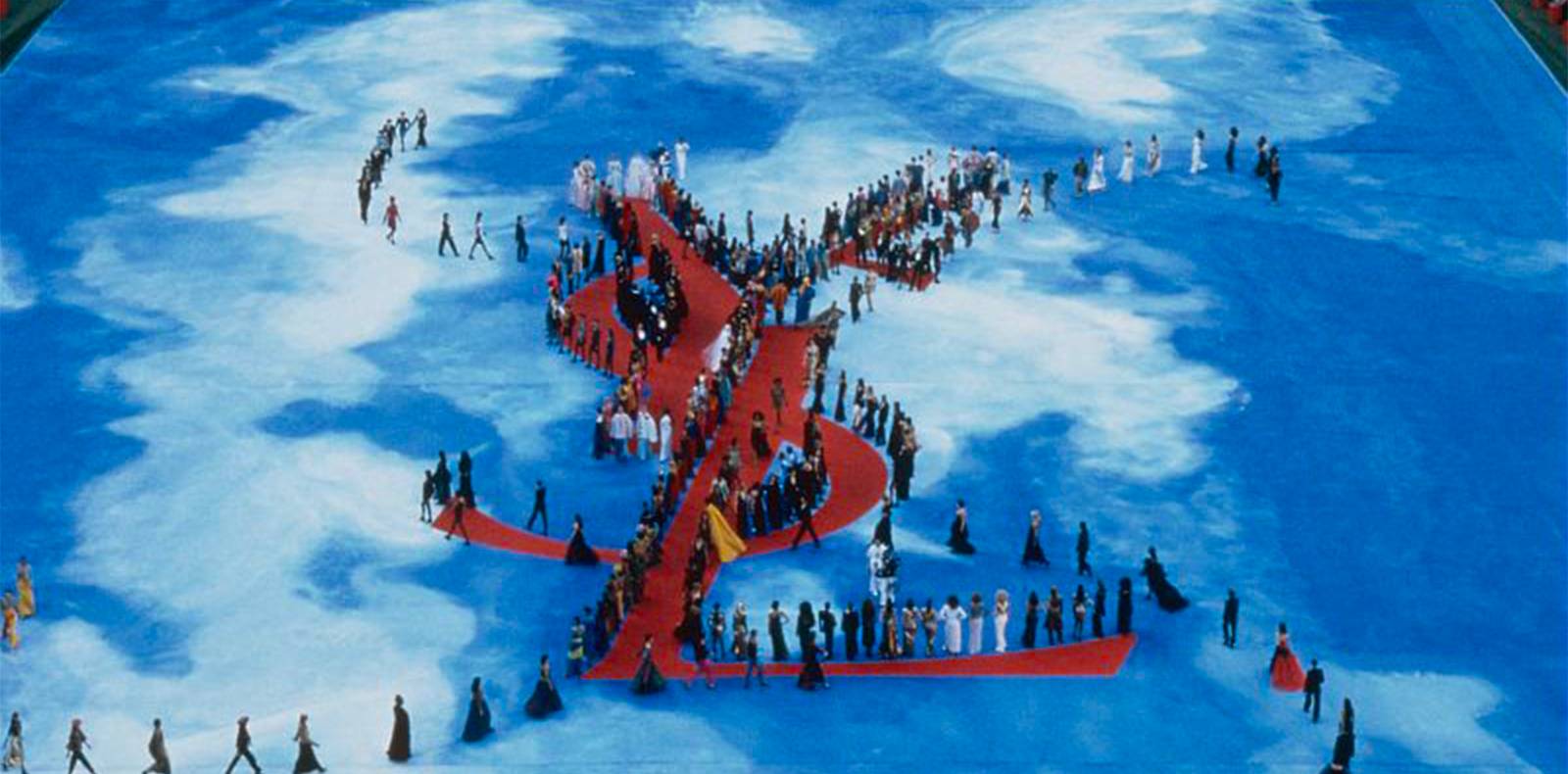
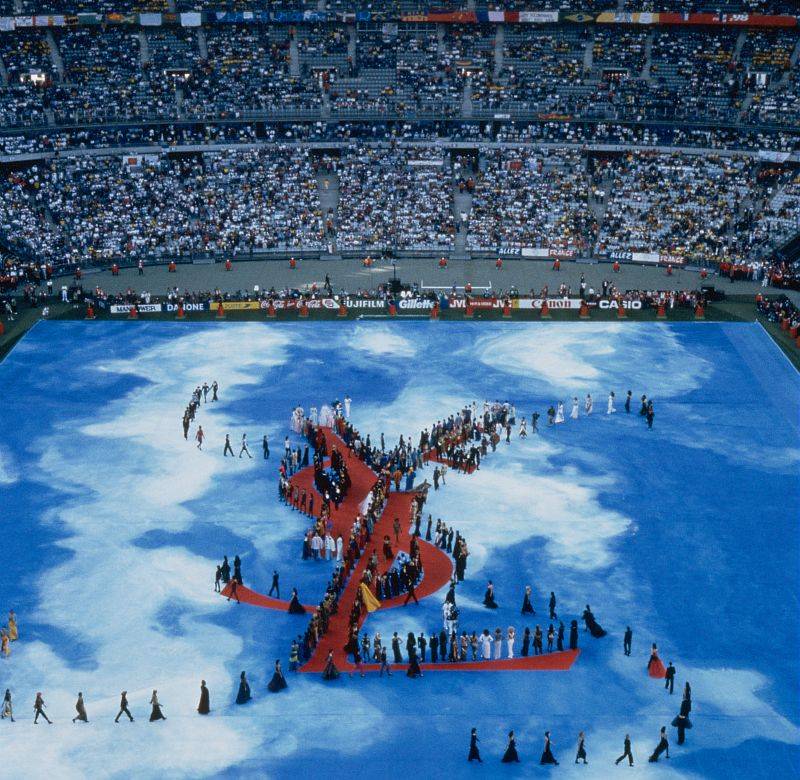
Yves Saint Laurent was better known for the elegance of his shows rather than for their extravagance. However, on 12th July, 1998, he made an exception. Hosted at the Stade de France during the World Cup final, the show was held in front of the 84,000 people in the stands of this memorable game and its 1.7 billion television viewers. The tremendous audience, equal to the designer’s career, celebrated the legacy of his house, which opened in 1962. Filling a stadium with his or her creations was something no designer had ever imagined before: except Yves Saint Laurent, who brought together more than 300 pieces from his archives for the occasion, scouring through 174 of his collections.
As a result, his safari jacket walked across the pitch of the Stade de France, followed by his iconic tuxedo trouser suit, his Mondrian dress, his jackets embroidered with quotations by Cocteau and Apollinaire… In all, the fifteen-minute show required the expertise of more than 900 people, including a host of supermodels such as Carla Bruni, Adriana Karembeu, and his muse Laetitia Casta. In a six-part choreography, the outfits were organised by theme, with the models joining in the centre of the field for the finale, forming the famous YSL logo created by the renowned Ukrainian graphic designer Cassandre (1901 1968), visible from the stands. A remarkable demonstration of Yves Saint Laurent’s influence on French culture. Three years later, he retired from the world of fashion.