
6
6


Who is Miles Greenberg, the flamboyant artist and performer on show at Reiffers Initiatives?
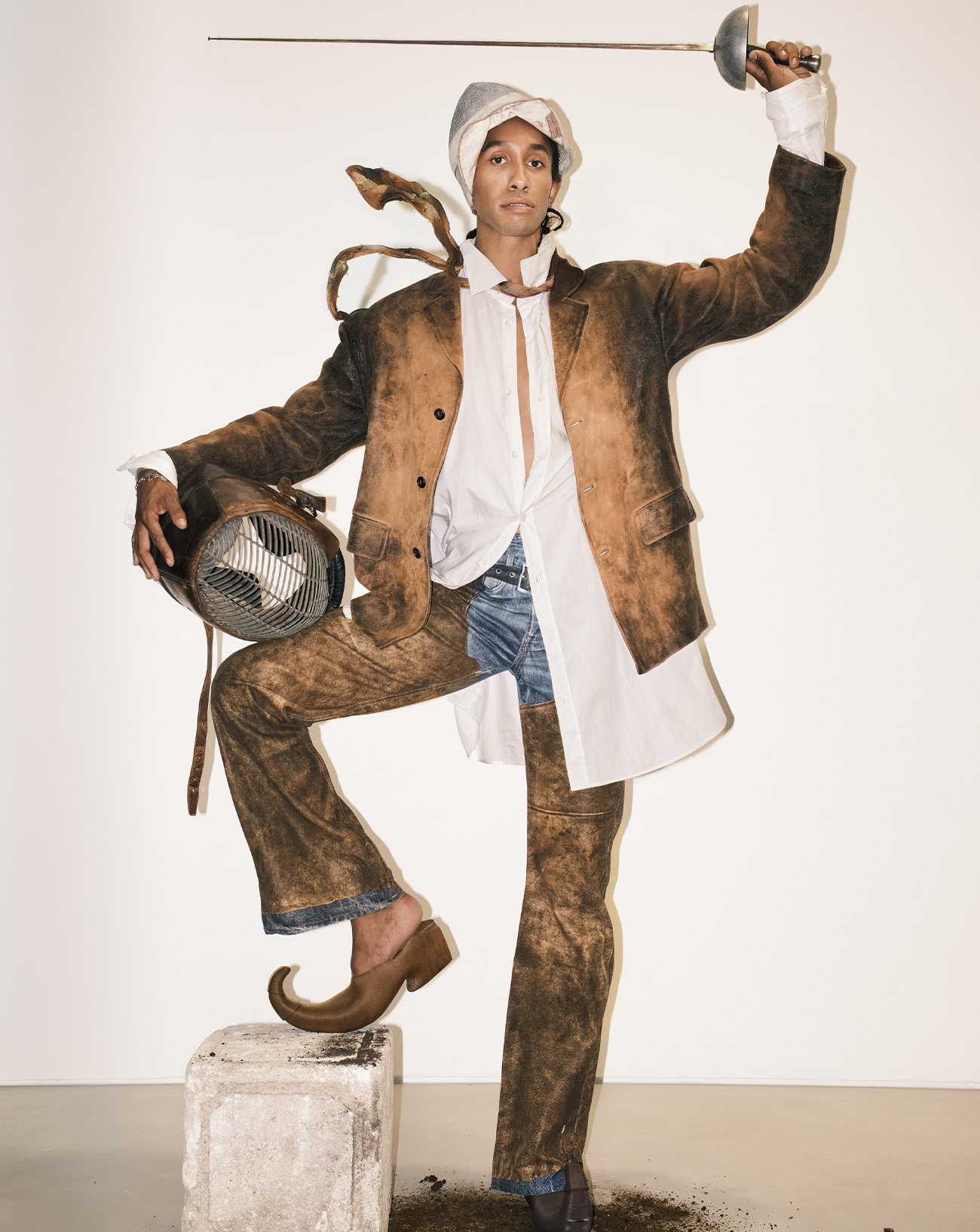
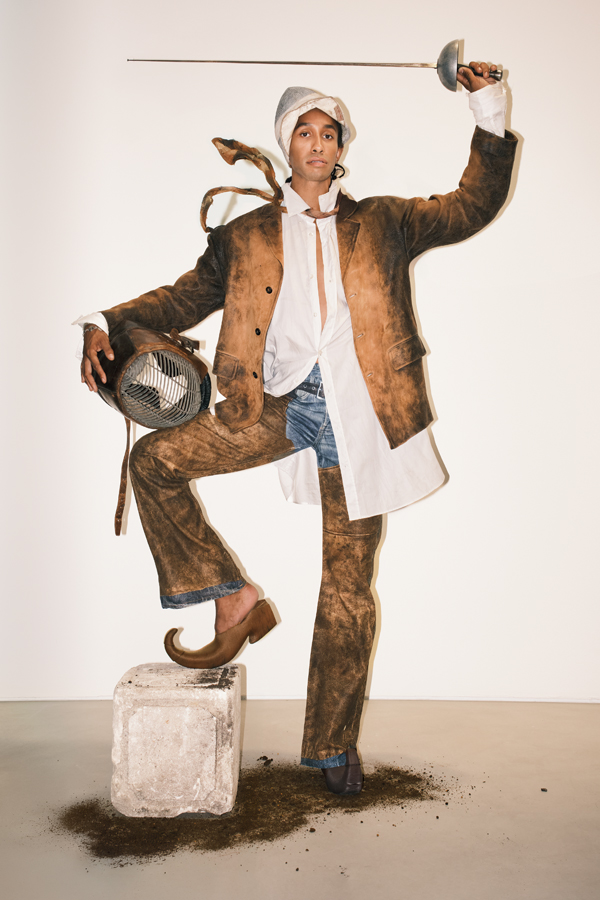
Text by Olivia Anani, portrait by Vidar Logi .
Numéro art 17 is available at newsstands and on iPad since October 18th, 2025.
Miles Greenberg, the rising star of art on show in Paris
Miles Greenberg’s upbringing was anything but conventional. Raised by his mother, an artist who was passionate about experimental theatre and the most avant-garde contemporary art of her time, he grew up surrounded by adults, and at the age of six entered the formal schooling system with reluctance. It was therefore quite natural that, as a teenager, he took his education into his own hands, seeking out apprenticeships with artistic masters, as was the custom in the Middle Ages and the Renaissance. After moving to Paris to study drama at the legendary Jacques Lecoq theatre school, he refined his study of movement with the Canadian choreographer Édouard Lock, and completed his education with the American stage director Robert Wilson as well as with the very exacting Serbian performer Marina Abramovic, whose rigour, physical endurance, and almost military self discipline he shares, not to mention an interest in spirituality.
It might therefore seem surprising that Miles Greenberg does not frame his work through the lens of prestigious philosophical texts, contemporary theory, or even art history. Instead, he draws on sensations, childhood memories, emotions, and dreams. Recently, he’s been fascinated by a scene from Polish author Stanislas Lem’s Solaris, the 1961 science fiction novel made famous by Andrei Tarkovsky’s 1972 film adaptation. In the book, scientists attempt to communicate with an alien intelligence that, despite all their efforts, will only reply, like a monstrous mirror, with anthropomorphic visions taken from their own minds.
The first of these “visitors” is a woman, a Black woman to be precise. Lem’s description of her recalls the tragic story of Sarah Baartman, the “Hottentot Venus,” leaving the reader unsettled by the profusion of details used to express the terror inspired by this “repulsive” (I quote), deformed, disturbing vision, without explaining why – her supposed monstrosity and “unnatural” otherness are taken for granted.
Referred to exclusively in the third person, she is as passive as any anthropological subject and never allowed to speak. Like a spectre, she appears at the end of a corridor, behind a piece of furniture, only to vanish from the story just as she entered it, without a sound. Unlike a ghost however, she does not have the privilege of transparency or immateriality, since her physical body is, after all, both her foremost characteristic and her greatest flaw.
Performance as coming-of-age tale
We should remember that the novel appeared in 1961, a year after a wave of independence movements swept across Africa, offering the world the image of a modern continent supposedly freed from colonial rule and ready to seize a future that seemed, at the time, full of promise. What Lem seems to be telling us, however, is that the ghosts of our shared history, even when silenced, will continue to haunt us for a long time to come, both privately and collectively, on Earth and even in the furthest reaches of space.
The “Venus” in Solaris suggests that scientific progress has never been neutral and that, if it is not accompanied by moral and spiritual growth, it will remain a mirage. In his work, Miles Greenberg attempts to reconcile a series of contradictory notions, like one of those impossible flower bouquets in Flemish still lifes: the material and the immaterial, the tangible and the intangible, yin and yang, body and mind, wear and transcendence, the fleeting instant of a human breath and the enduring lifespan of the stars, the organic and the technological, spirituality and data, the past and the future.
“Miles Greenberg completed his education with the American stage director Robert Wilson and with the very exacting Serbian performer Marina Abramovic.”
His performances read like an initiation journey, as in Malian author Amadou Hampâté Bâ’s Kaidara – we must return to them again and again to grasp the lessons that ignorance had previously concealed from us. One could also cite the initiation journey undertaken by Kusanagi, a character in Masamune Shirow’s manga Ghost in the Shell, or the American philosopher Donna Haraway’s iconic cyborg theories, if only they hadn’t been so widely challenged for their insufficient engagement with the weight of colonialism in shaping today’s world. This includes current concerns around technology and the learning biases of artificial intelligence, which the American author Ruha Benjamin has wittily nicknamed the “New Jim Code,” in reference to the Jim Crow laws that perpetuated racial segregation in the United States.
Highly-acclaimed works, from New York to Venice
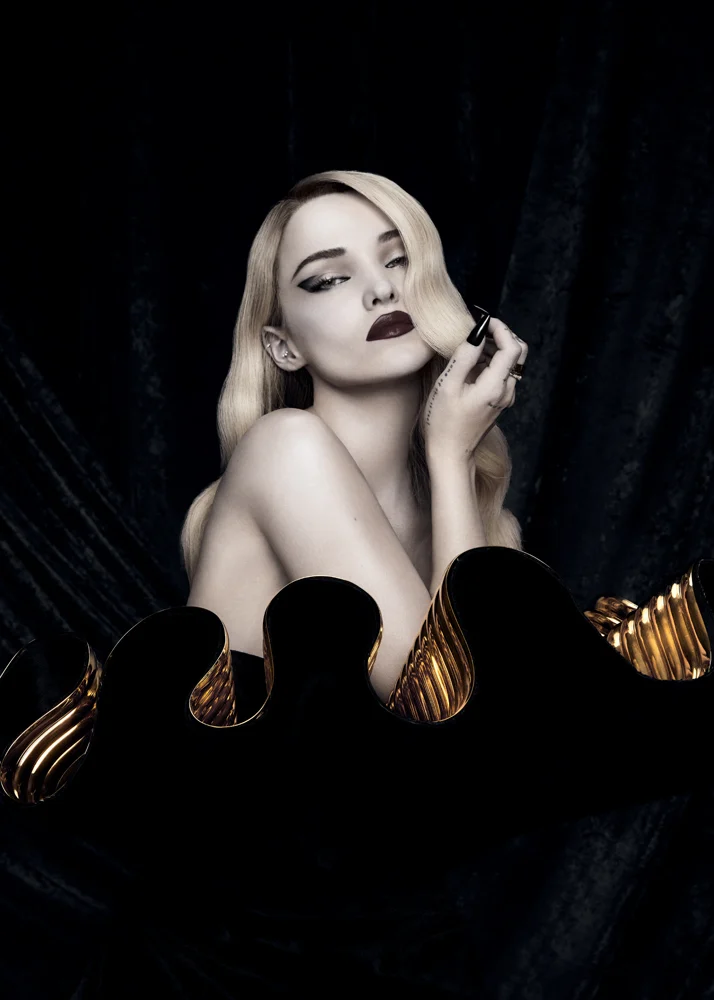
Just as the ghosts of the past linger on in our memories, so certain characters, objects, sensations, and scents return in Greenberg’s performances, as if to remind us that everything is interconnected. In Chandelier (2015), his first performance ten years ago, the artist referenced the blackamoors of Venetian sculpture – silent, ornamental servants that carry candelabra, tables, and columns. Suspended from the ceiling by chains and leather straps, and holding three candles in his fingers and toes, the blindfolded Greenberg invited visitors to feast beneath his body until the last bottle was opened. Echoing the work of the Chinese master of performance Zhang Huan, the piece lasted over two and a half hours.
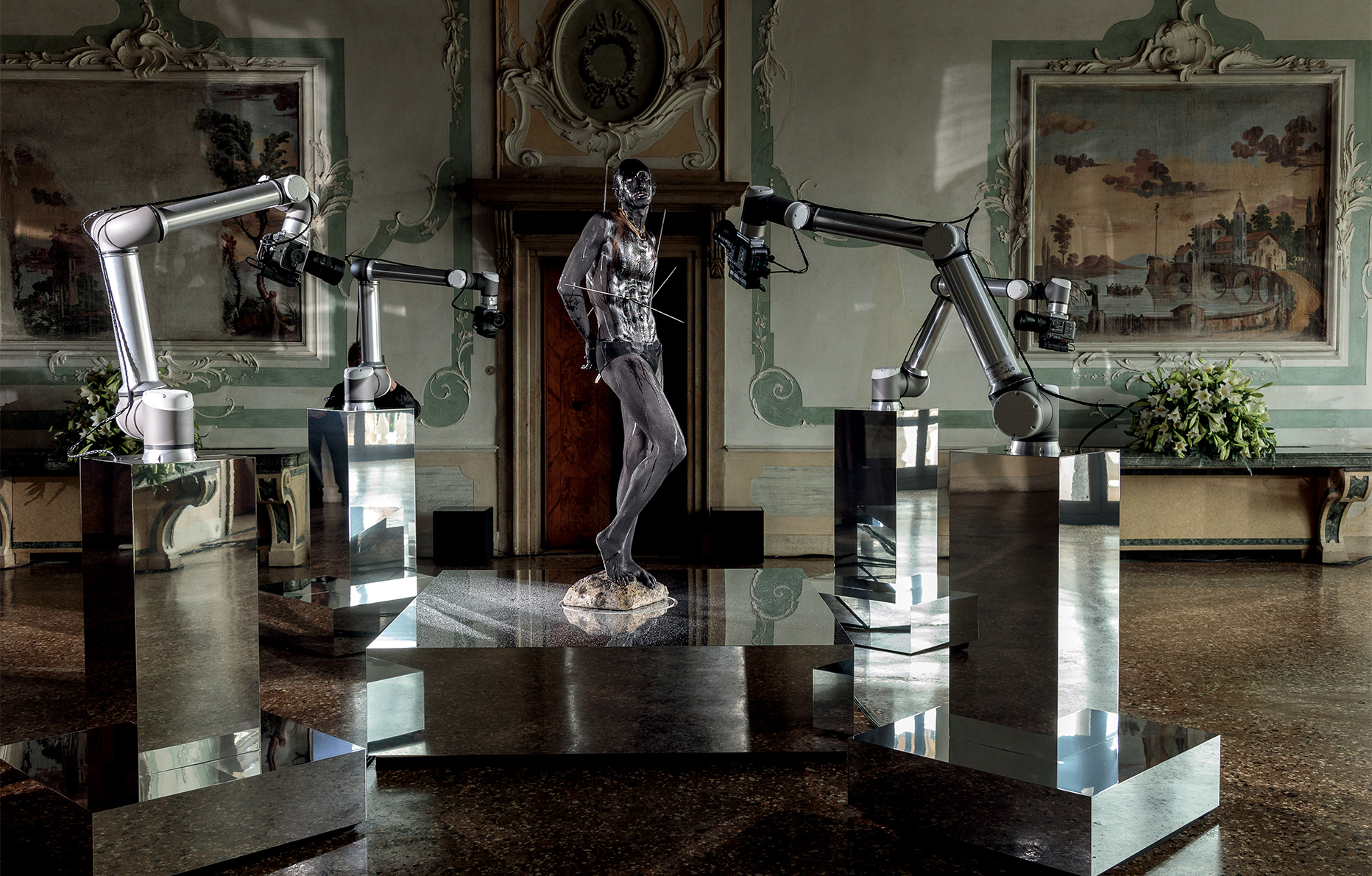
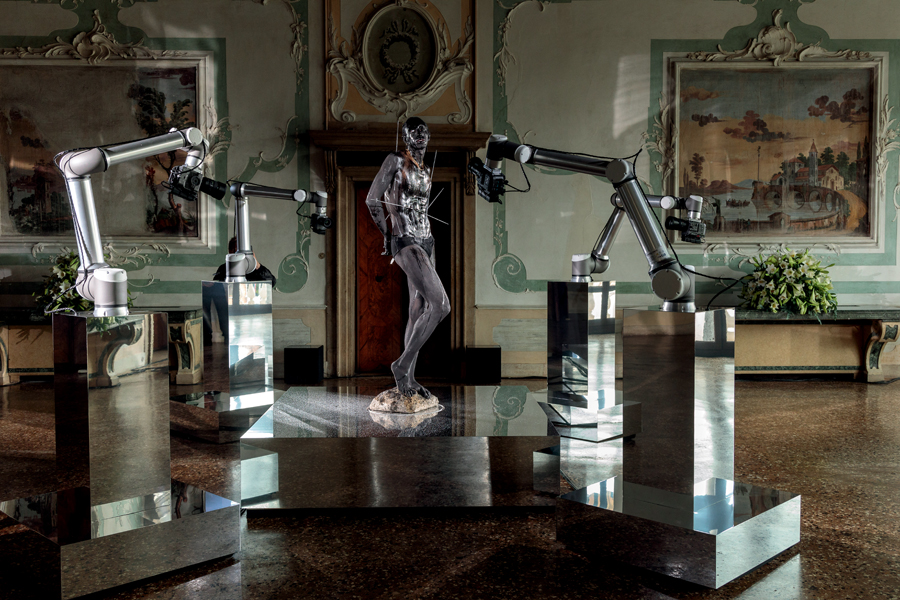
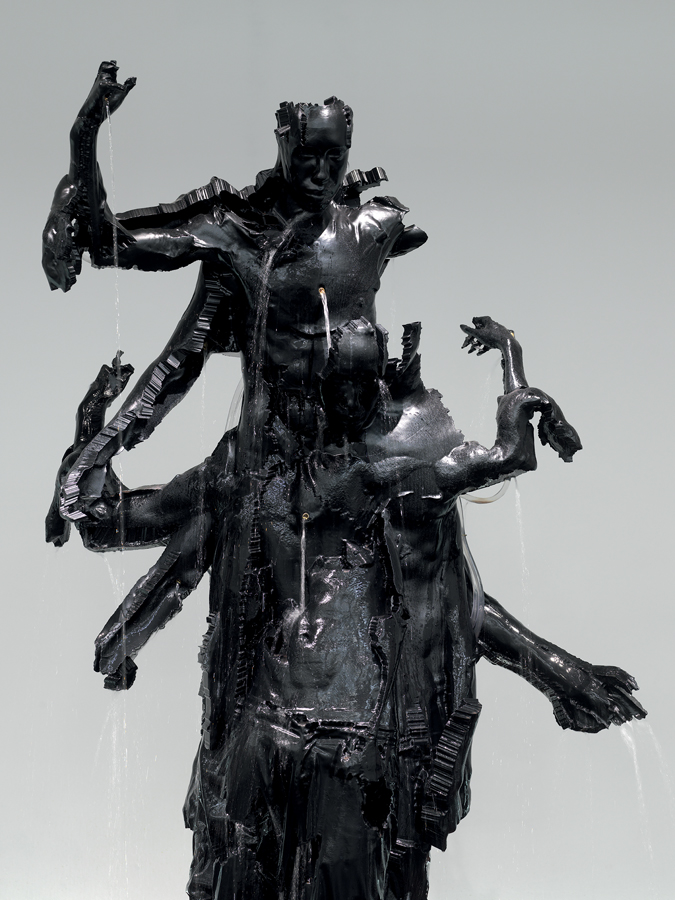
Nine years later, the blackamoor figure, crafted in bronze, marble, or ebony, returned as a silent witness in Greenberg’s highly acclaimed performance on the fringes of the 60th Venice Art Biennale, curated by German-American Klaus Biesenbach. Pierced by real arrows and captured by cameras, whose glassy gaze could equally well have been accusatory or compassionate, this Venetian Sebastian followed a first act performed by the artist behind closed doors in the Louvre’s Cour Marly a year earlier. Étude pour Sébastien (2023) came in the wake of an impressive four-week residency at the Palais de Tokyo, commissioned by the Italian curator Vittoria Matarrese in 2019, during which Greenberg brought together over a dozen performers in a series of living tableaux titled Alphaville Noir (2019).
“Certain characters, objects, sensations, and scents return in Greenberg’s performances, as if to remind us that everything is interconnected.”
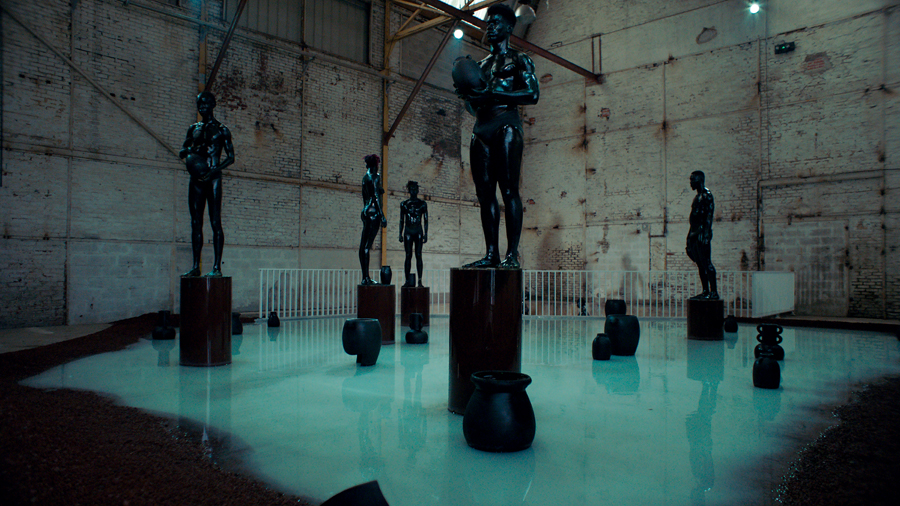
The conveyor belt, which Greenberg first used in his 24-hour performance Oysterknife (2020), staged at the height of the COVID pandemic, is all set to make a forceful comeback in a future work. As for Hæmotherapy I (2019) and Pneumotherapy II (2020), both performed in New York, they solicited the audience’s sense of smell, which became an essential part of the experience. Red and turquoise-green liquids often accompany Greenberg’s installations and performances, while the pedestal serves as a tool for both the physical and the ideological elevation of the symbolic figures he summons. Another recurrent trope is the use of white (and black, to systematically cover his body), which reference both Japanese butoh and West African initiation rituals, during which the body is coated in kaolin as an act of spiritual cleansing.
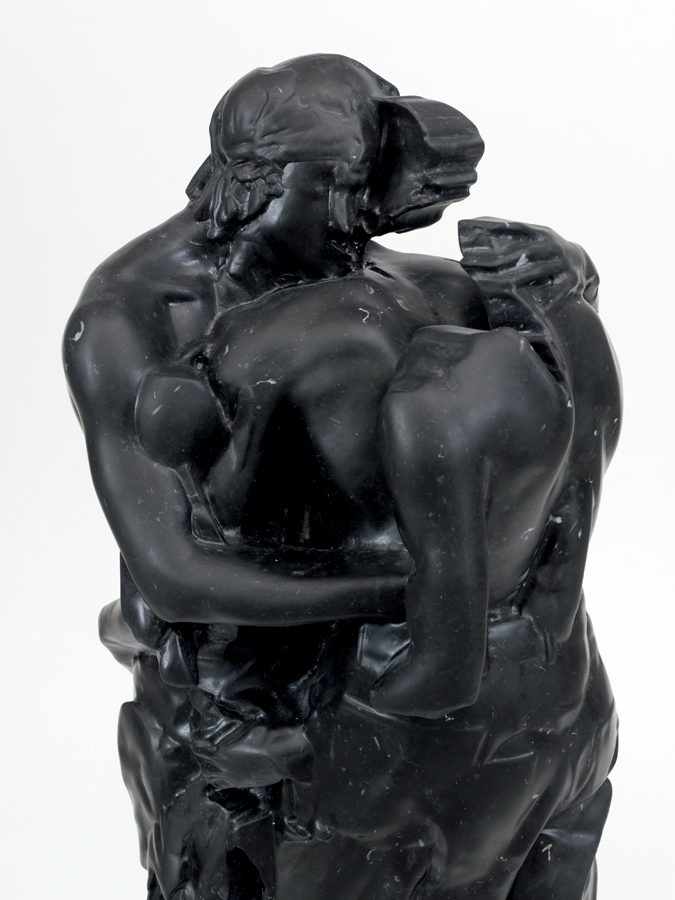
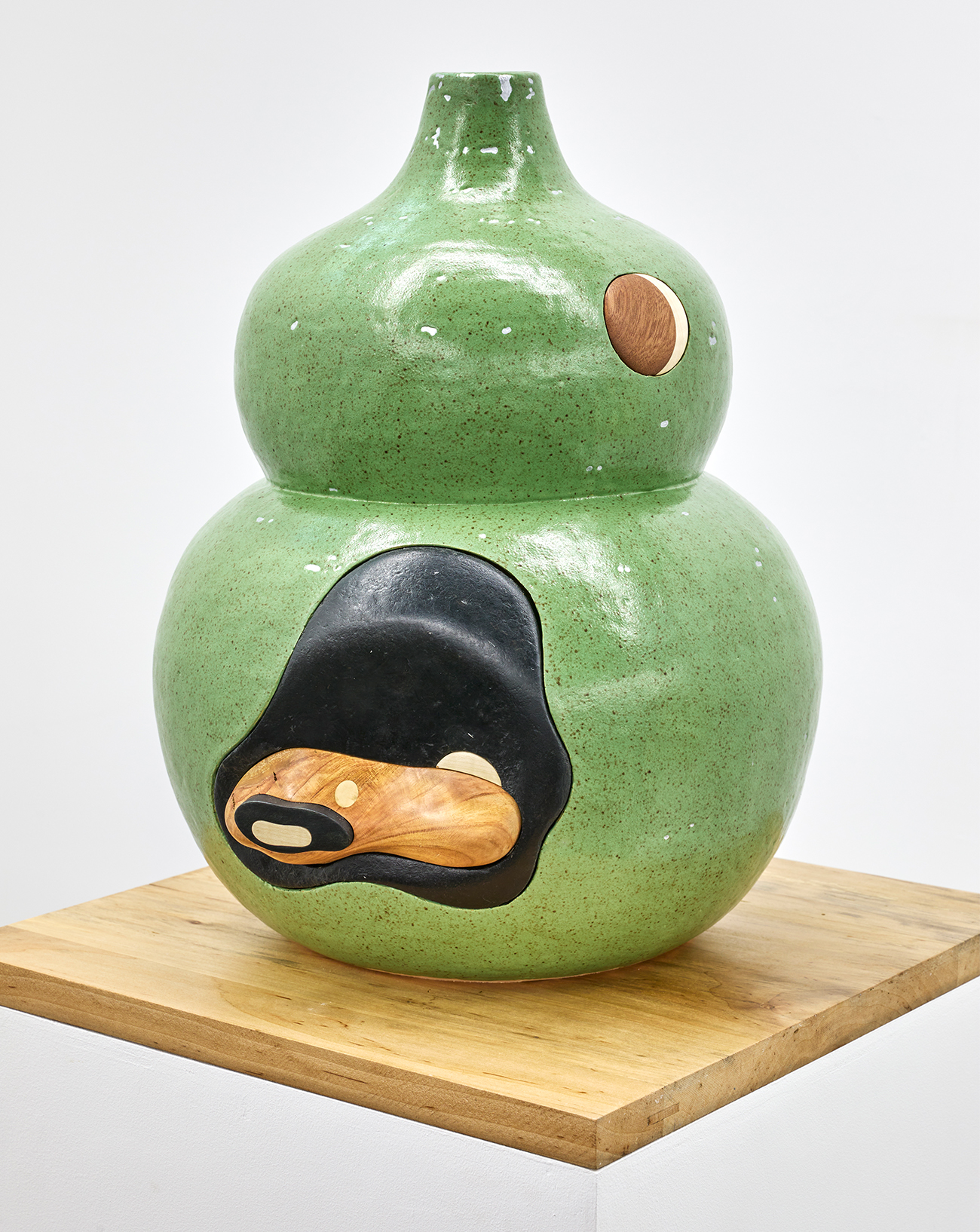
Courtesy of the artist and Salon 94, New York.
A dialogue with Daniel Buren exhibited at Reiffers Initiatives
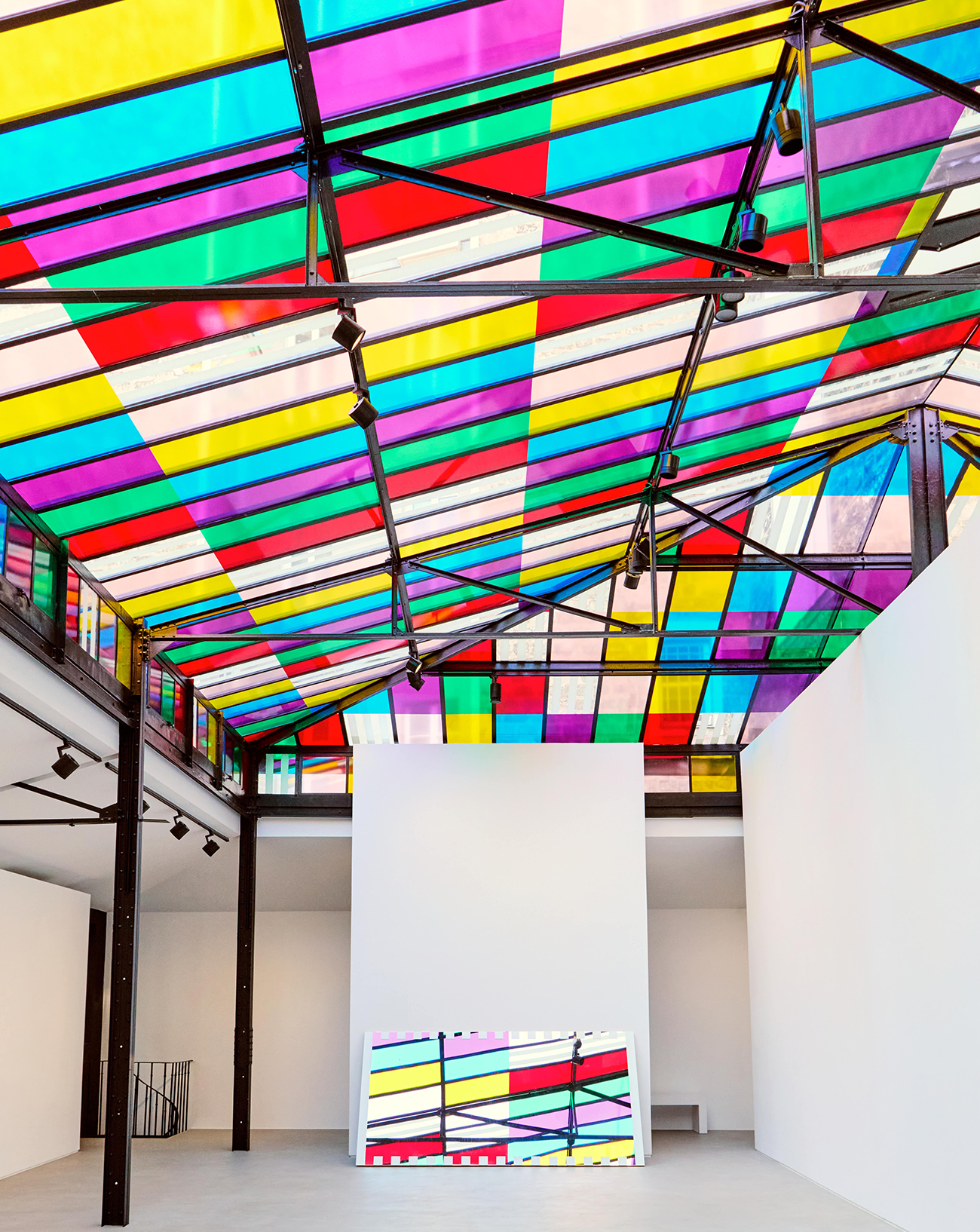
For his Reiffers Initiatives mentorship, Miles Greenberg drew on Daniel Buren’s exploration of light to reflect on the tension between the visible and the invisible. What chimeras do we summon up in the secrecy of our collective and private struggles, be they spiritual, symbolic, or ideological? And what does it mean to bring to light what previously belonged to the realm of shadows, as evoked by the Japanese writer Jun’ichiro Tanizaki? Were the ocean in Solaris to probe our minds today, one wonders what kinds of monsters would now emerge.
“Daniel Buren and Miles Greenberg.” 2025 Mentorship exhibition, from October 24th to December 13th, 2025, at Reiffers Initiatives, 30 rue des Acacias, Paris 17th.