

10
10


Interview with Patti Smith: “An artist can inspire, thrill and encourage people to take action”
American rock icon and poet Patti Smith released a new EP in March 2025 and will celebrating the 50th anniversary of her cult album Horses with two exceptional dates in Paris this October. This is an opportunity to revisit our inspiring meeting with the punk priestess at the Centre Pompidou where she unveiled an exhibition.
Interview by Violaine Schütz.
After producing three albums together between 2019 and 2021, Patti Smith and the New York-based artistic and musical duo Soundwalk Collective created Evidence, an immersive installation at the Centre Pompidou.
From October 2022 to January 2023, they offered visitors a sonic, metaphysical and poetic experience. An invitation to dive into the works of French poets “with soles of wind” Antonin Artaud, Arthur Rimbaud and René Daumal.
A new EP and a tour scheduled for 2025
The installation featured mesmerizing musical creations, with the voices of Charlotte Gainsbourg and Charlotte Rampling, Patti Smith’s own pictorial works, as well as a collection of objects coming from the three poets’ travels – Ethiopia, India and Mexico. Numéro met the sparkling punk priestess at the museum, in a small group setting, to talk about the power of poetry, climate change and feminism.
The singer’s latest EP with Soundwalk Collective was released last March. Now, the singer is about to embark on a world tour and will be stopping in Paris to celebrate the 50th anniversary of Horses, her cult album reissued in a remastered digital version in October 2025. Throwback to that memorable exchange.
Interview with singer Patti Smith
Numéro: How did you and Stephan Crasneanscki, the New York-based French artist and creator of Soundwalk Collective, meet?
Patti Smith: The funny thing is that this exhibition is all about travel. You see stones brought back from the beautiful mountains of Mexico, landscapes of India, and objects from the city of Harar in eastern Ethiopia. We actually met while travelling. I was returning from Morocco, where I was attending a festival celebrating the Beat Generation, and I was on a flight from Paris to New York. Stephan was sitting next to me. I don’t usually talk to people on the plane. But he was reading a book about Nico, who was part of The Velvet Underground.
Did you know the singer Nico well?
Nico was my friend. I’ve read many books about her, but I didn’t know that one. So I asked him about it and he told me that he was working on a musical and poetic project about the final days and hours of Nico. I asked him, “Who’s going to read Nico’s poems?” He said, “I don’t know yet. We’ll find someone.” Then, I spontaneously said, “I’ll do it. She was my friend. I think I understood her.” The next day, I went to Stephan’s studio in New York, which was just a short walk from my home, and we started working together. When we finished the album Killer Road (2016), we thought, “We can’t just part ways like this, it’s kind of sad. Let’s do more!” So, we embarked on a trilogy project about French poets we loved: René Daumal, Arthur Rimbaud and Antonin Artaud. Stephan and I met in the sky, which is always a good start for a long-lasting collaboration.
“I’ve been reading Rimbaud for over half a century, since I was 15.” — Patti Smith
What do you have in common?
Stephan had already begun researching Rimbaud. As for me, I’ve been reading Rimbaud for over half a century, since I was 15. So, reading his poetry for this project was a job made for me, as much as experiencing it through his travels. We wanted to explore his stay in Harar, Ethiopia, through the songs of Sufis lulled by the wind and the rain. That’s how the album Mummer Love (2019) about Rimbaud was born. We focused on the end of his life, which is less known than his early French years when he wrote Une saison en enfer (1873) and Illuminations (1886).
Then we decided to work on another project, and we chose a poet we both loved: Antonin Artaud. I started reading him at the age of 20. This poet is celebrated as the handsome young man in the film The Passion of Joan of Arc (1928) and as the inventor of the concept of the Theatre of Cruelty with his book The Theatre and Its Double (1938). But people know less about his peyote rituals in Mexico. He wrote about them in The Peyote Dance, 1987. That fascinating part of his life is what we explored with Stephan.
And what about the poet René Daumal?
René Daumal (1908–1944) is less known than Artaud and Rimbaud, but his writing is so beautiful. As a young writer and poet, he used to be a punk, a real rock star. He told the Surrealists to go to hell, as he wanted to go further beyond their movement. To reach his goal and transcend the mere surrealist dreams, he took a lot of drugs to expand his consciousness. However, in his quest to disrupt all his senses, he had a very dangerous, intoxicating trip using tetrachloromethane [he originally used the substance to kill the beetles he collected, Ed.].
He learned some literary lessons from it that allowed him to dive into another world, but he also destroyed his lungs. Because of that, he couldn’t fight the tuberculosis he was diagnosed with in his thirties. He died too young, at the age of 36, just before World War II ended.
We don’t know much about him indeed…
Stephan and I didn’t focus on the young Daumal. Instead, we explored the most difficult and challenging part of his life, when he was trying to work while fighting tuberculosis and dreaming of climbing mountains in India, especially a sacred one he wanted to write about. Neither did he climb that mountain, because he died of his disease, nor did he finish his masterpiece, the adventure novel Mount Analogue (1952). Stephan and I decided to continue the journey for him, this physical, mental, and spiritual journey in the mountains.
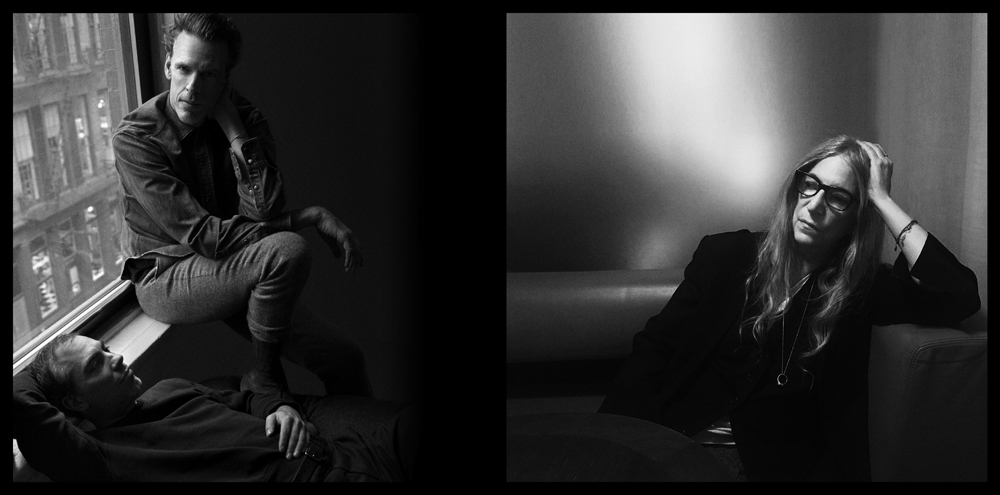
“I think it’s wonderful and very important that revolutionary efforts are being made to give a voice to women and the transgender community.” — Patti Smith
Your exhibition at the Centre Pompidou highlighted three men…
I don’t see them as men. I’m interested in their poetry first. I’m interested in the work of women as much as men. And I don’t think God cares about our gender. I’m a humanist. I have a son and a daughter, and to me, their rights are equal. I want both my son and my daughter to have a beautiful life. But I think it’s wonderful and very important that revolutionary efforts are being made to give a voice to women and the transgender community.
We are facing a terrible climate crisis. How can music, art and poetry have an impact in all this?
This global crisis is probably the biggest one we have ever faced. Every action is important, from Greta Thunberg and youngsters marching in the streets to people cleaning up public spaces and fighting against the government or big corporations. In this context, a poem or a song can help. A poem or a beautiful song alone won’t change anything, but the people reading or listening to them can make a change. Poetry, music, and art can inspire people to take action. But, we need millions of people to unite.
“Activism is not easy. It’s hard, ruthless and even heartbreaking.” — Patti Smith
Do you believe that’s possible?
We need a global movement. The other day, I saw a little girl picking up litter on a beach. She ended up cleaning the whole area on her own. So, imagine if a million people decided to clean the rivers. We have to roll up our sleeves and do our bit. So, if a poem can push us to do so, then God bless this poem. Before the pandemic, little Greta Thunberg was doing everything she could to start a movement. Millions of children marched in the streets everywhere, but then the pandemic set that fight back. Now we would like to start all over again, but we don’t have any time to lose. We have to do it now. Otherwise, we will walk alone on this earth, and we will no longer see the beautiful things it offers, such as gazelles crossing a plain.
How can a poem inspire people to take action?
In 1986, me and my late husband Fred “Sonic” Smith [Frederick Dewey Smith, who died in 1994, was the guitarist of the band MC5 and his name inspired Sonic Youth, Ed.] wrote a poem called People Have the Power in 1998, and we made a song out of it. It was a song that people could use for their activism and to give them energy. Activism is not an easy task, it is hard, brutal, and even heartbreaking. My daughter, Jesse Paris Smith, is a climate change activist. Being an activist means constantly failing because you are lobbying big corporations and people who don’t really care about these issues or don’t even listen to you. Yet, it is so important to be heard.
“What can an artist do in all this? Inspire, thrill, encourage people.” — Patti Smith
What role can artists play?
So what can an artist do in all this? Inspire, thrill, encourage people. This little song my husband and I wrote together has since travelled the world. This morning, someone sent me a video from Iran, showing young girls fighting for freedom. Girls there die fighting for freedom every day, just so their hair can blow freely in the wind. This song gave them momentum during a protest.
Could you remind us of the lyrics?
Let me recite the lyrics (she begins to chant the People Have the Power in a spoken-word style, ed.):
“I was dreaming in my dreaming / Of an aspect bright and fair / And my sleeping it was broken / But my dream it lingered near / In the form of shining valleys / Where the pure air recognized / And my senses newly opened / I awakened to the cry / That the people have the power / To redeem the work of fools / Upon the meek the graces shower / It’s decreed the people rule / The people have the power.”
“In the 1970s and 1990s, when I did interviews or small press conferences like today, there was a majority of men.” — Patti Smith
Do you feel things have changed since the start of your musical career?
In the 1970s and 1990s, when I did interviews or small press conferences like today, there was a majority of men. I am happy to see that today, there are almost exclusively women. Things have really changed. I think we are living in a very beautiful period of time because there are so many female artists, poets, scientists, and activists. Especially through books, we are rediscovering and valuing the women who have been unfairly forgotten in our history. I have just finished a small book called A Book of Daysinspired by Instagram. It contains 365 photographs. Like the social media, each day refers to an image and a caption.
Anything you would like to add about this book?
When I was doing my research, I came across a young black scientist who lived in Hawaii in the 1920s. At that time, there was a big leper colony in Hawaii. She had discovered a treatment using the oil from the seeds of a tree to relieve the pain and allow patients to see their friends and family. Her name was Alice Ball and she died at 24 after a terrible chemical accident during an experiment. Her research was taken up by a professor who removed her name and took direct credit. It is only recently that people have discovered that she was the one who did the work.
Correspondences Vol. 2 (2025) by Soundwalk Collective and Patti Smith, available now. Horses (50th Anniversary) (2025) by Patti Smith, available now. The singer will be performing live at the Olympia in Paris on October 20th and 21st, 2025.