
31
31


Louis Vuitton celebrates Japan in an exceptional exhibition in Osaka
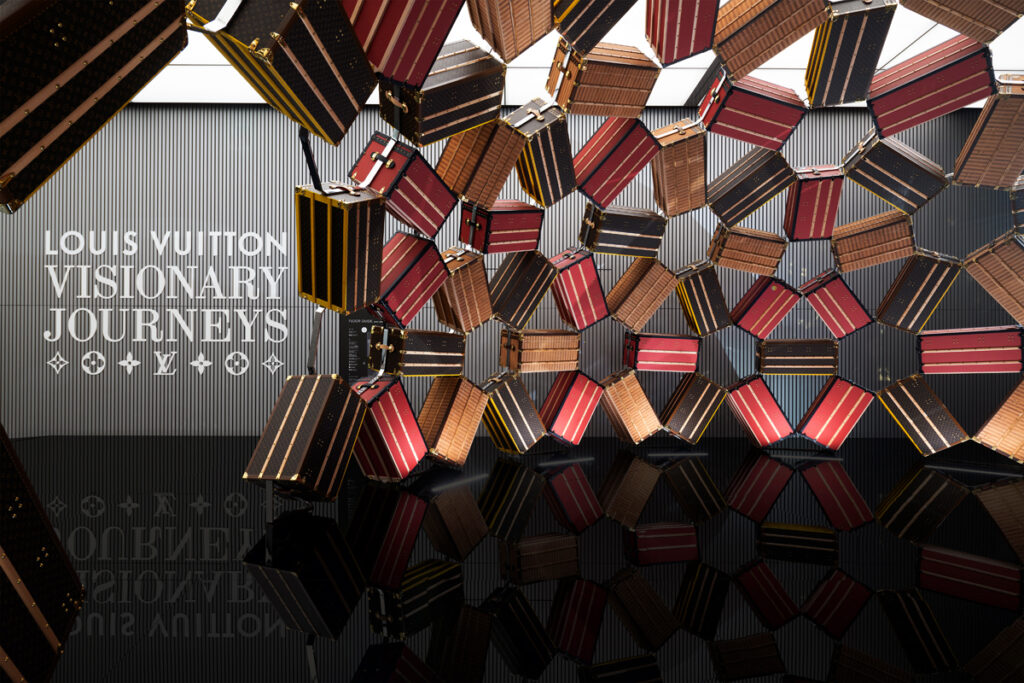
For the Osaka 2025 World Expo, Louis Vuitton is taking over the spectacular space of the Nakanoshima Museum of Art to present Visionary Journeys. This exceptional exhibition celebrates both the 170th anniversary of the house and its deep connection with Japan. For the occasion, Numéro art spoke with Florence Müller, the exhibition’s curator.
In Osaka, Louis Vuitton celebrates its ties with Japan
A true visual odyssey, the exhibition Visionary Journeys offers a unique twelve-chapter dive into the evolution of the house. Craftsmanship and the art of travel dear to Louis Vuitton are the highlights of this exhibit. Visitors will have the chance to discover no fewer than 1,000 objects, including more than 200 specifically linked to Japan.
“Visionary Journeys”: an exhibition showcasing 1,000 objects
It is perhaps in the “Louis Vuitton in Japan” room that the house’s fascination with Japanese aesthetics and culture is the most obvious. “This room offers a large panorama of the Japanese sources of inspiration behind Louis Vuitton creations,” Florence Müller explains. “It features a part of a toiletry kit inspired by the geometric shapes of tsubas (“sword guards”) drawn from Gaston-Louis Vuitton’s collection of 800 pieces. A 1833 woodblock print by Hokusai, depicting the Kirifuri Waterfall on Mount Kurokami and on loan from the Guimet Museum, is presented alongside a 1933 puzzle made for Sacha Guitry that uses the same iconic image of the waterfall.”
“A photograph also recalls a display created by Gaston-Louis Vuitton for the Champs-Elysées store in 1921, during the official visit of Hirohito, future emperor of Japan. This life-size display, shaped like a Japanese garden, evoked one of the famous prints from the Mount Fuji series. That display proved to be extremely popular with passersby.” Proof that Japan is not merely a formal inspiration, but a cultural bridge that Louis Vuitton has continually crossed.

A long-standing love story
The relationship between the house and Japan goes back much further than we might think. Sameshima Naonobu is the very first Japanese client identified in the archives. The plenipotentiary minister of Japan travelled to Paris in 1874 to acquire trunks. “In the exhibition, this very first Japanese client is illustrated for the first time through his portrait, loaned by the Komaba Museum in Tokyo, and his mention in the client account book,” Florence Müller emphasises. Moreover, the fascination with Japan may date back to the 1867 Paris World’s Fair, when the country had its first national pavilion. “The Vuitton family became close to representatives of Japonism in France and began collecting Japanese artworks,” she continues.
The Monogram canvas, a major first tribute
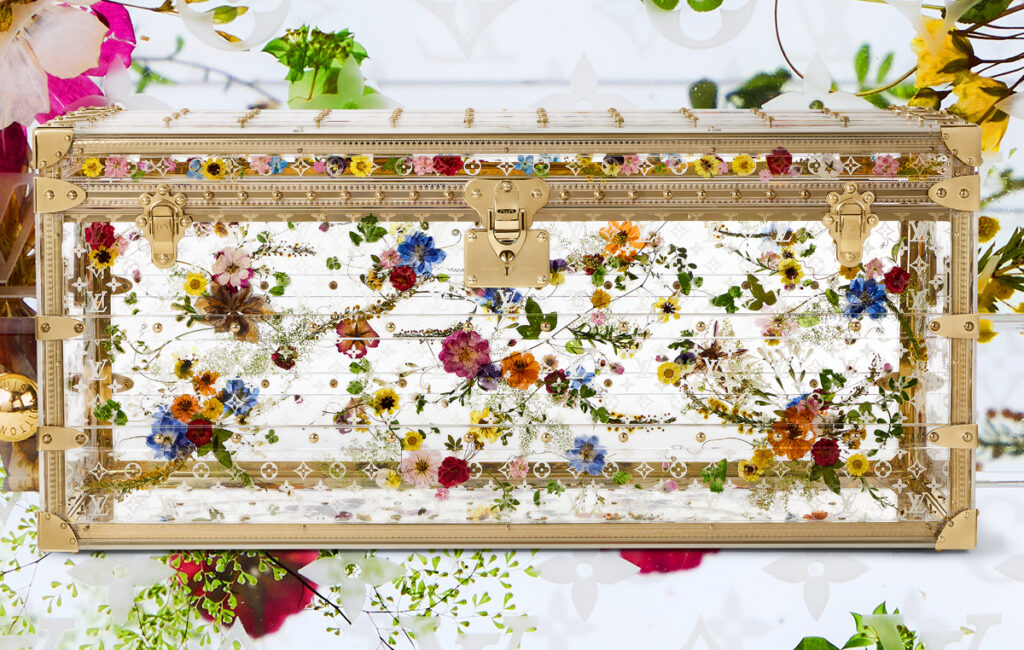
Among the emblematic objects attesting to this connection, the Monogram canvas, created in 1896 by Georges Vuitton, holds a central place. Its origins may be linked to Japanese graphic traditions. “Even though the Japanese origin of its motifs remains hypothetical, as explored in the book Louis Vuitton – Japon, published for the occasion,” Florence Müller notes. “Throughout the exhibition, numerous documents analyse its potential stylistic roots, including motifs found in medieval European architecture, in furniture and objects kept in the Vuitton family collections.”
“A magnificent trunk said to have belonged to Shogun Tokugawa, on loan from the Guimet Museum, reveals similarities between its Mon (family crest) motifs and those of the Monogram canvas. Georges Vuitton most likely saw this trunk on display at the 1878 Paris World’s Fair, where it was acquired by Emile Guimet before being showcased during the museum’s opening in 1889.“
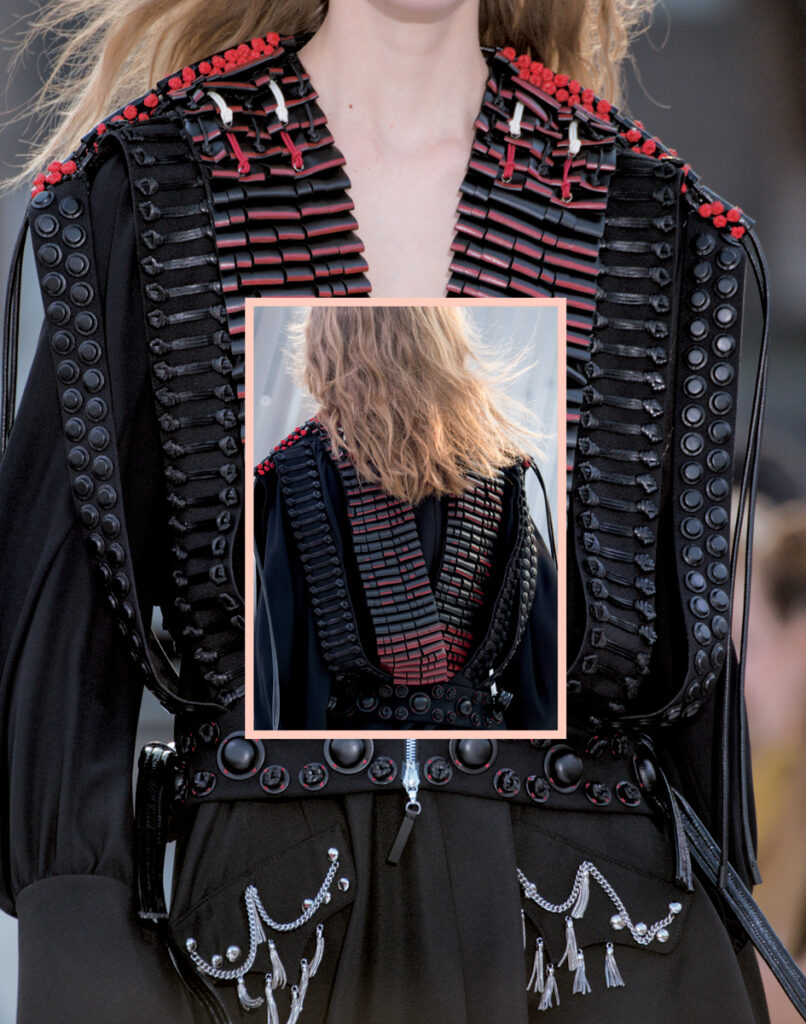

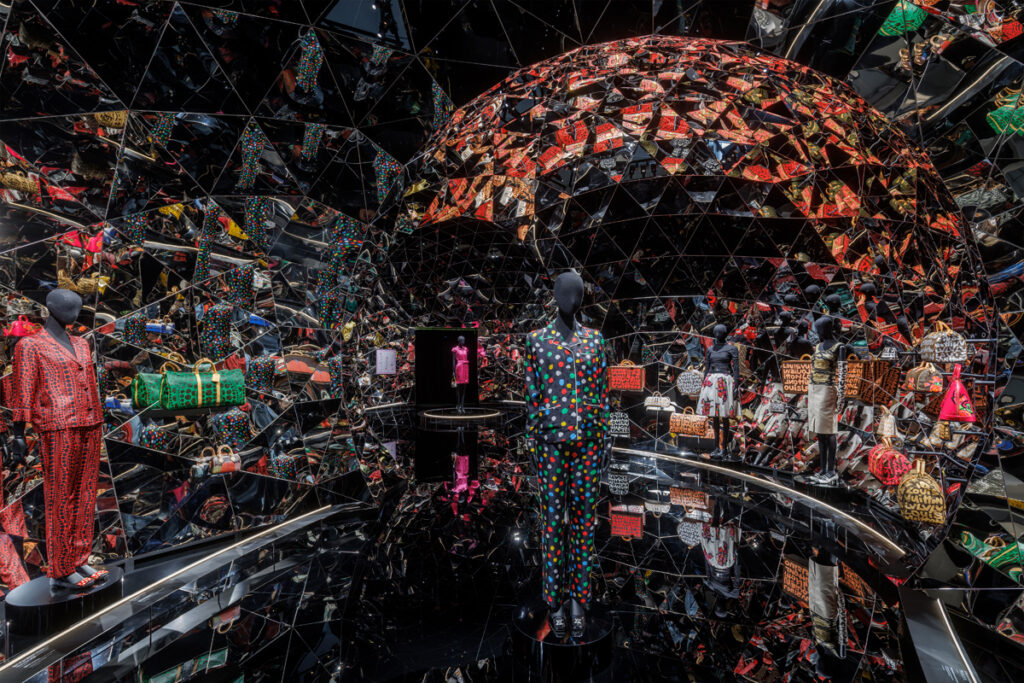
Another rare item in the exhibition is a sample from the original Monogram design registration, on loan from the Paris Archives and shown for the first time. Displayed with its original box and permanent registration label, the sample sits in a showcase at the center of a circular room designed by the exhibition scenographer Shohei Shigematsu (OMA). It is surrounded by a constellation of Monogram canvas bags from different time periods, orbiting like planets around the sun.
Designers inspired by Japan, from Nicolas Ghesquière to Virgil Abloh
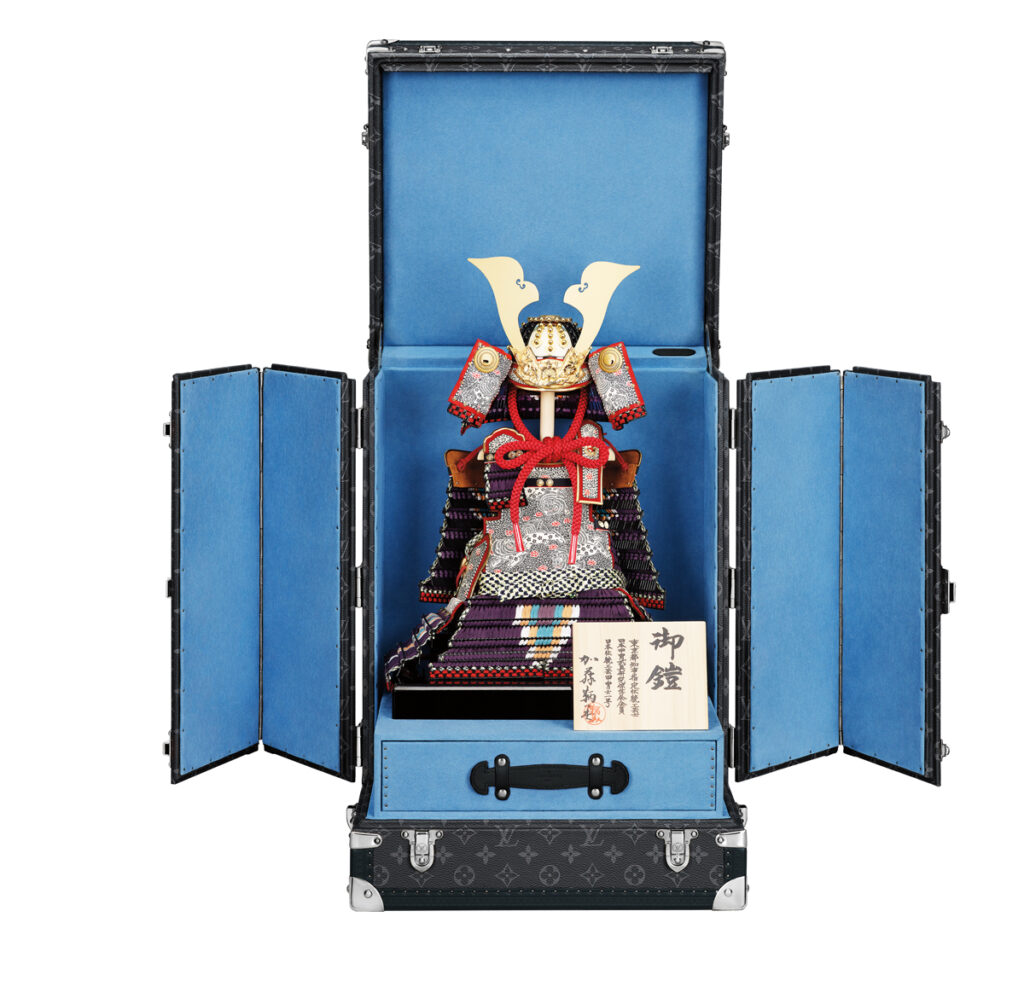
The exhibition wouldn’t be complete without mentioning the designers and artists who have recently embodied this fascination. Virgil Abloh and his bags inspired by Koi-no-Bori, Kim Jones with his silhouettes borrowing from the kimono, Nicolas Ghesquière and his lantern bags and samurai-style dresses. Each one of them has infused Louis Vuitton’s wardrobe with a touch of Japan.

Takashi Murakami x Louis Vuitton: a landmark collaboration
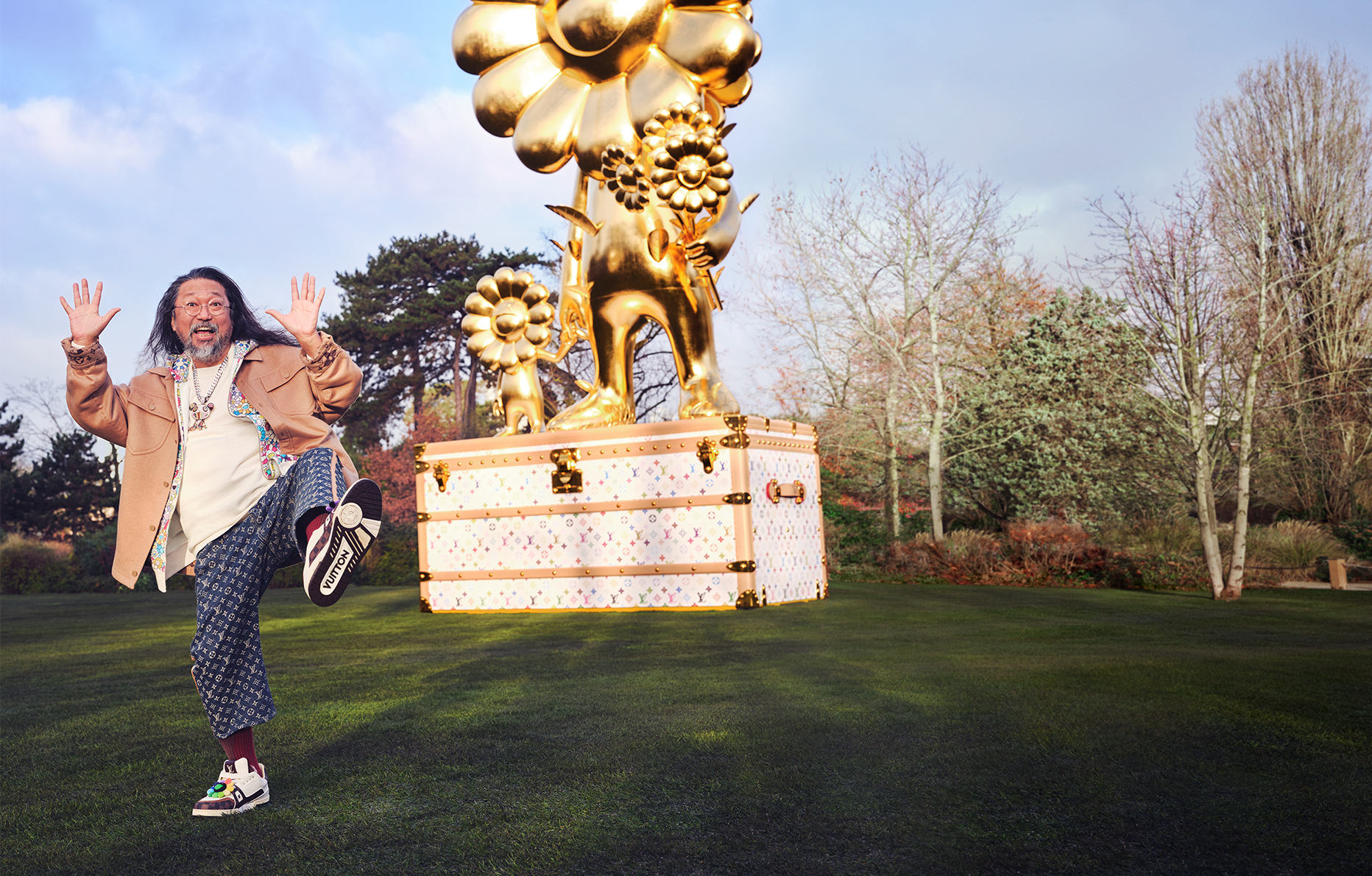
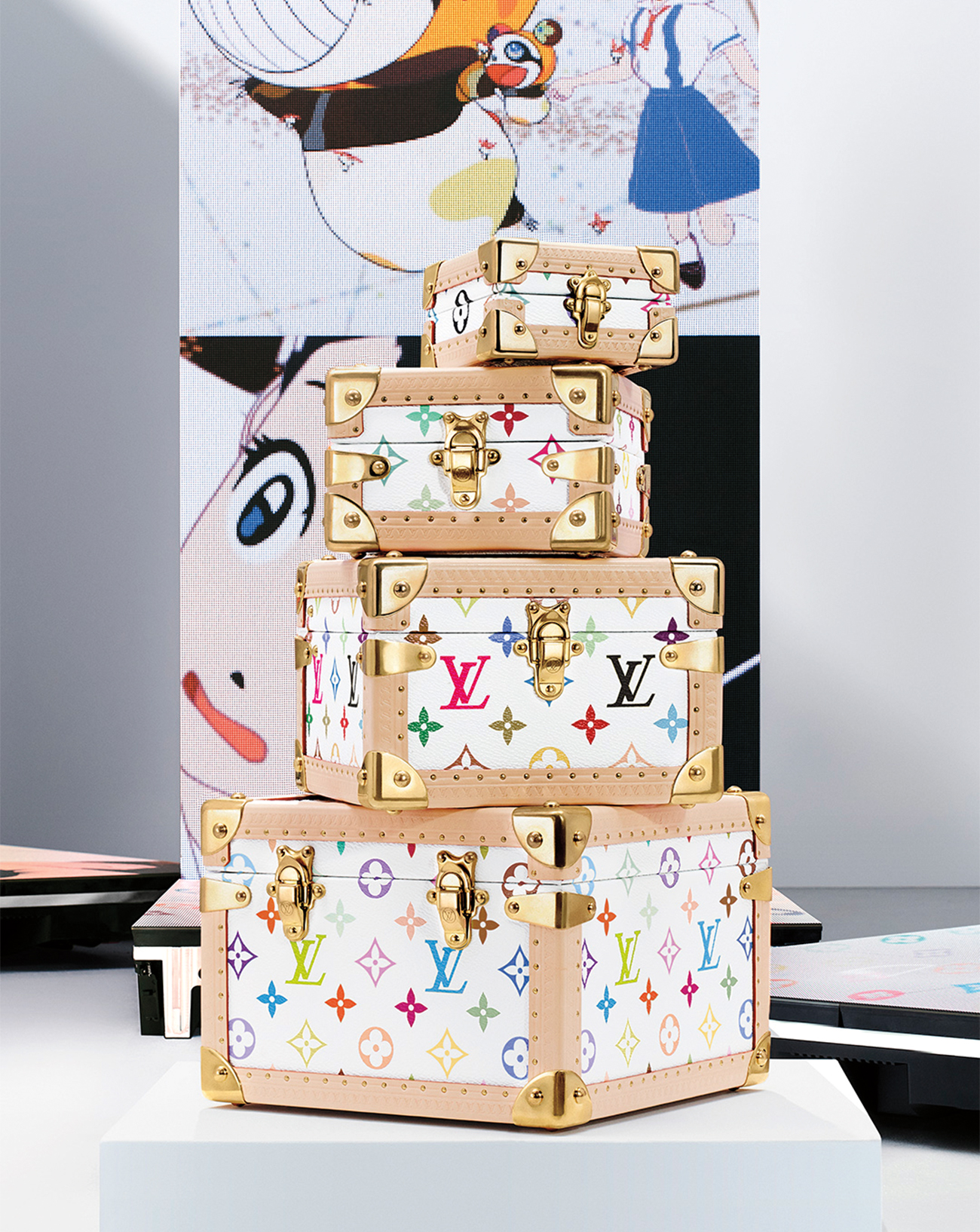
“Many pieces reflect Louis Vuitton’s taste for traditional Japanese objects and ceremonies,” Florence Müller underlines. This includes the brand’s iconic collaborations with Japanese creatives. Among them are Hiroshi Fujiwara, Kansai Yamamoto, Comme des Garçons, Nigo, and Takashi Murakami. In fact, it all began with Murakami in 2002. “The first collaboration with a Japanese artist was initiated by Marc Jacobs with Takashi Murakami. At the time, the idea was to reinterpret the famous Monogram canvas for its 150th anniversary,” the curator recalls. Murakami went on to transform the house’s visual language with the Multicolore Monogram, Monogramouflage, and Cosmic Blossom Monogram.
Visionary Journeys is a vibrant tribute, a declaration of admiration from a fashion house for a culture it has engaged with for over a century. A reminder that the art of travel is also the art of encounters.
“Louis Vuitton: Visionary Journeys”, open until September 17th, 2025, at the Nakanoshima Museum of Art in Osaka, Japan.