22
22


Mickalene Thomas in 3 works that challenge art history at the Grand Palais
At 54, Mickalene Thomas is one of the most influential contemporary American artists. Following her exhibition at Les Abattoirs Museum in Toulouse last summer, the largest monographic show of the visual artist’s career is now on view at the Grand Palais in Paris until April 5th, 2026. Throwback to three decades of hybrid, political art practice through three powerful works that have consistently played with the canons of Western art.
Published on 22 December 2025. Updated on 7 May 2026.
1. From muse to protagonist: Déjeuner sur l’herbe
Mickalene Thomas’s exhibition at the Grand Palais just opened a few days ago. And just like the artist herself, her works have traveled a lot. From The Broad in Los Angeles to the Barnes Foundation in Philadelphia, the Hayward Gallery in London, and Les Abattoirs in Toulouse, “All About Love” closes its world tour in Paris. This is the artist’s most ambitious art show in the French capital to date. A new iteration that carries special resonance, as the American artist has drawn many of her inspirations from Paris since the beginning of her career, nearly three decades ago. Especially from the work of artists who are now central to the city’s major museums.
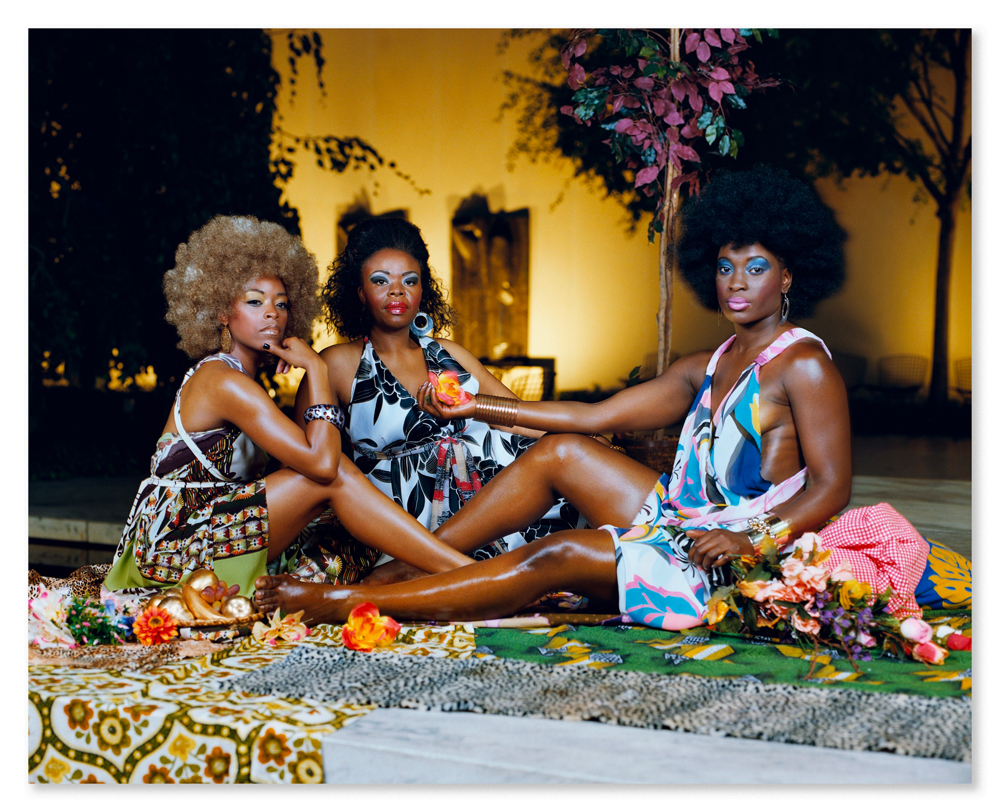
A striking example can be found in the second room of the exhibition, where three women are seated down in a park, their eyes meeting the visitor’s gaze. The arrangement of the figures and their direct stares are unmistakable references to Manet’s Déjeuner sur l’herbe (1863). Taken in 2010 in the MoMA’s sculpture garden on a commission by the New York museum, and previously shown in Paris three years ago in dialogue with works by Manet at the Musée de l’Orangerie, this large photograph brings together many of the central themes that run through Mickalene Thomas’s practice.
When Mickalene Thomas revisits art history
The monumental composition takes another look at art history and classical portraiture. Through the artist’s lens, it asserts a queer aesthetic that rejects Western beauty standards – standards largely rooted in the depiction of white women. Drawing on the legacy of Western art masters, who for centuries portrayed Black figures through the lens of exoticism, and even racism, the artist replaces the two clothed men and the nude woman – all white in the original painting – with three triumphant Black women. Their skin gleams, and their colorful clothes draw their inspiration from the “super-fly” aesthetic of the 1970s, closely tied to African-American empowerment. There is nothing passive about their posture. They sit upright and proud, taking ownership of the role of muse to become protagonists in their own right.
2. The art of self-portraiture: Afro Goddess Looking Forward
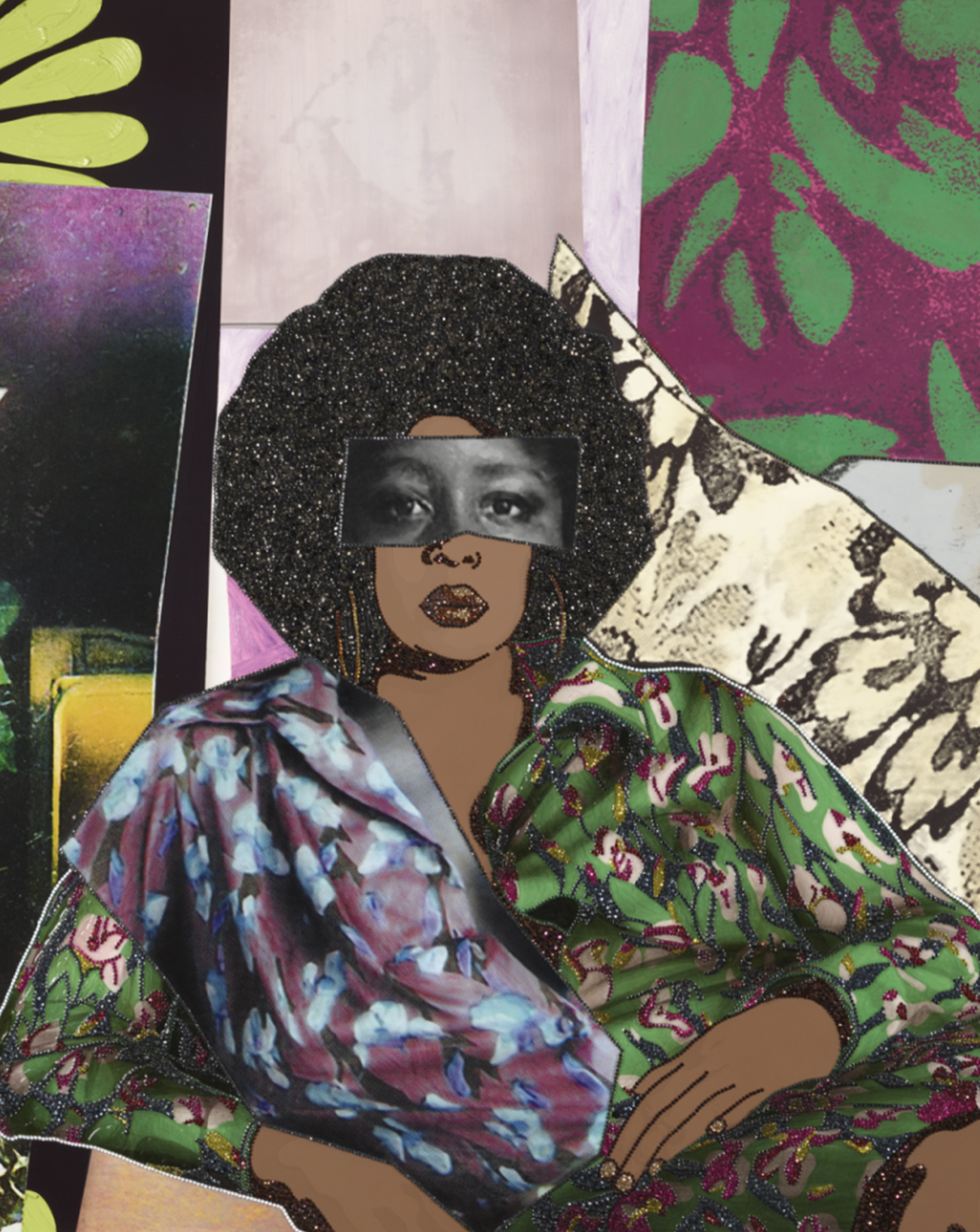
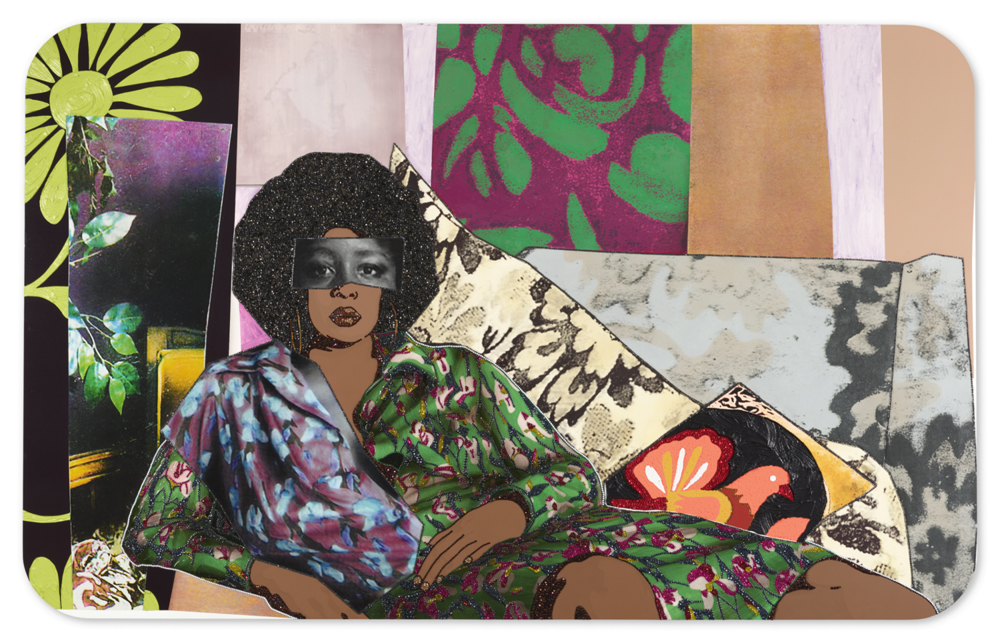
A little further on in the exhibiton, we encounter another woman. This time, it’s Mickalene Thomas herself, who appears almost lying down, once again meeting the viewer’s gaze. However, her gaze is fragmented here by a patchwork of prints and colors emblematic of the aesthetic references and techniques that shaped her. Born in Camden, New Jersey, in 1971 at a time still deeply marked by racial tensions in the United States, the young artist studied at the Pratt Institute in New York, then at Yale, where she discovered the work of artist and activist Faith Ringgold, whose influence is clearly felt in Mickalene Thomas’s use of collage and vibrant color palette.
In this work, titled Afro Goddess Looking Forward, we can see Mickalene Thomas’s distinctive, unconventional creative process, where photography, collage, and painting intersect. Most of her artworks begin with photographs of sets she constructs in her Brooklyn studio. Then, she enriches these compositions with layers of oil or enamel paint, multicoloured rhinestones, and fragments of images.
A free, political practice of collage
In Mickalene Thomas’s work, self-portrait is central. Here, she poses like an odalisque, in a posture reminiscent of Manet’s Olympia (1863). She is resting, one arm on her stomach, her gaze fixed steadily on the viewer. But unlike the portrait of her French predecessor, the American artist excludes any bourgeois setting or colonial references, replacing them with layers of floral prints in the background and on her dress. In fact, her gaze is the only element taken from a photograph.
In black and white, her eyes offer a sharp, yet calm and severe contrast from the rest of the composition. The artwork enters into a dialogue with Western art history, borrowing its pose while overturning a traditionally male-dominated pictorial tradition. The Black woman appears not only in the foreground, but also in front of the painting, becoming the author rather than a mere muse. As Mickalene Thomas writes of the female figures that populate her exhibition at the Grand Palais: “They have all the power and agency needed to compel the viewer to meet them in their own space, rather than being exploited or scrutinized.”
3. Collage, from rhinestones to political tool: Guernica
Beyond the classics of Western art history, Mickalene Thomas’s work is deeply rooted in contemporary and popular culture, drawing from cinema, music, and television. As the Black is Beautiful movement, which challenged the imposition of white aesthetic norms on Black communities, gained momentum in the late 1980s, the young artist was shaped by the raspy voice of disco queen Eartha Kitt, the boldness of model Naomi Sims, and the commanding presence of actresses Whoopi Goldberg and Diahann Carroll. These figures emerge throughout her paintings, photographs and videos, several of which are featured in the exhibition.
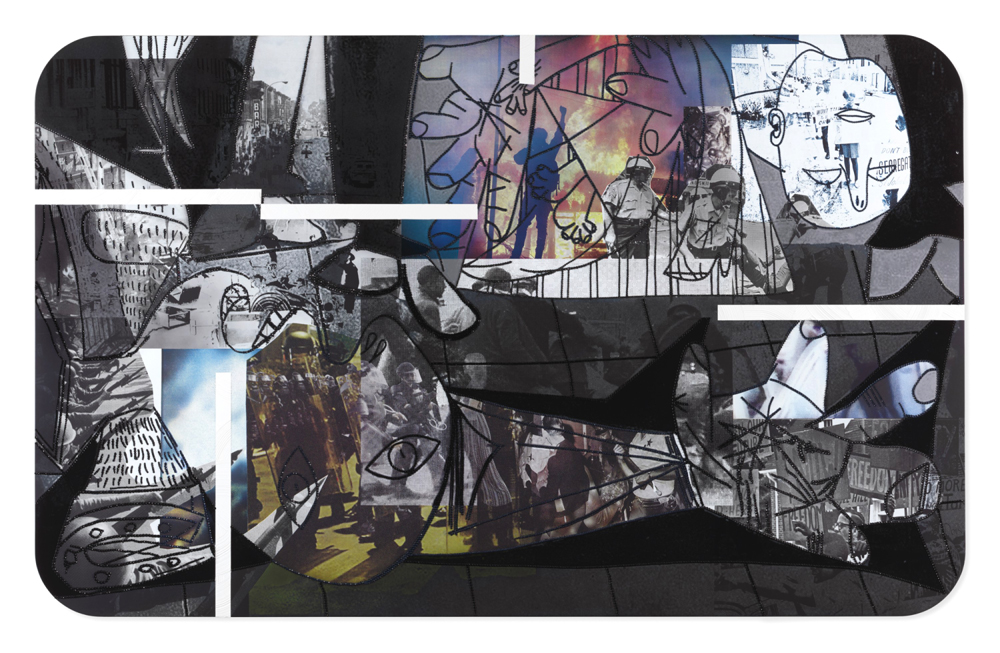
One piece in particular belongs to her Resist series (2021). Each image unfolds as a collage in tonal variations, blending protest photography with fantastical illustrations. In the penultimate room of the exhibition, visitors discover a large-scale video work, which is part of the Resist series. Its title and format once again echo one of the most iconic works of modern art, Guernica.
Collective memory and political collage
Within this series and composition, the artist draws our attention to the struggles of Black communities in the United States, particularly the history of civil rights activism from the 1960s to the present day. She overlays images of protests, both archival and recent – including recognizable Black Lives Matter slogans – linking them visually through bold black linework that either frames or cuts across each image.
For Guernica, Mickalene Thomas envisions the piece as a memorial to Black lives lost to police and penitentiary violence in the United States. In stark contrast to the glitter and vivid colours that define her earlier compositions, this work wields collage as a political instrument. One that exposes the brutality and injustice endured by the African-American community. It also serves as a form of collective memory, politically charged and formally unrestrained. “I define my work as a feminist and political act… I am Black, queer woman,” reads a declaration from the artist on the walls of the exhibition… Her own personal manifesto.
“Mickalene Thomas. All About Love”, until April 5th, 2026, at the Grand Palais, Paris 8th.