22
22


Jordan Peele, the director behind Nope and Get Out, in 5 obsessions
American filmmaker Jordan Peel is considered as the instigator of a new type of horror cinema. One that has emerged over the last decade and is giving the genre its former nobility. With three features to his credit, Get Out (2017), Us (2019), and Nope (2022), the American director has shaken up all the codes of the horror genre by mixing pop culture with auteur cinema, while offering a deeply moving experience. Numéro explores the universe of the new master of suspense and horror through five obsessions.
Published on 23 August 2022. Updated on 22 July 2026.
Get Out, a sharp criticism of American society
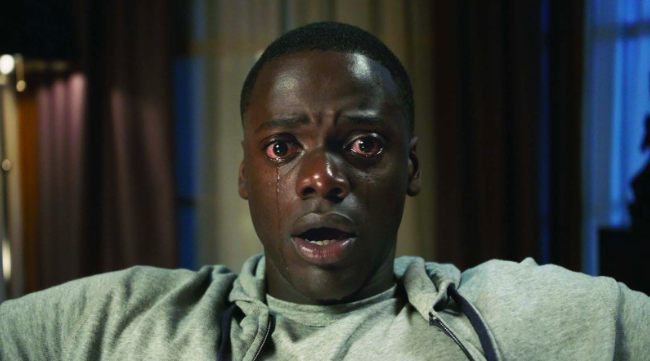
First a colonial-style house with a manicured lawn in Get Out (2017), then a modern middle-class secondary residence in the suburbs of Santa Cruz in Us (2019), and finally a ranch lost in the middle of the American plains near a gold rush theme park in Nope (2022)… In Jordan Peele‘s work, horror is always embedded in the banality of American daily life. In Get Out, Chris (Daniel Kaluuya) goes to his girlfriend Rose’s family home (Allison Williams) for the weekend. The remote house becomes the setting for a horrific social drama and a criticism of the still present legacy of colonization. Denuncing systemic racism is a leitmotif in the American director’s productions. They all depict a chilling portrait of the relations between black and white people, and of how an ultra-violent past that insidiously hides in the smallest details is at the foundation of those dynamics.
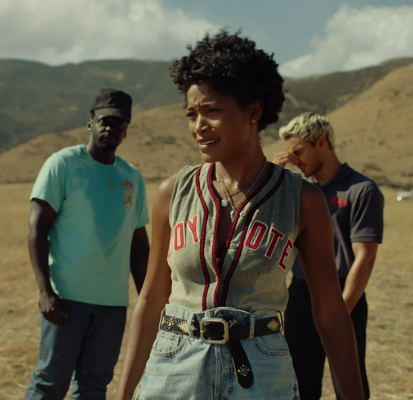
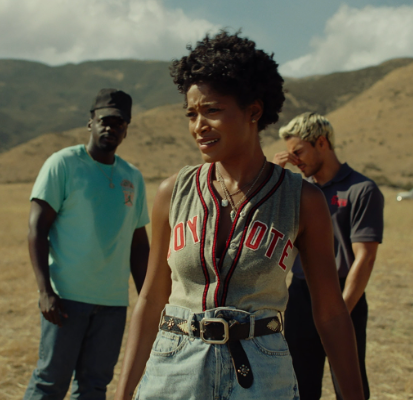
In Us, Jordan Peele combines a description of social class relations between a middle-class white family, with a bored alcoholic mother, Kitty (Elisabeth Moss), and a black family, whose mother Adelaide (Lupita Nyong’o). In Nope, the master of horror tackles a new myth, the American dream. A true variation on the need for celebrity, the many intertwined storylines weave a critique of the entertainment industry steming from capitalism taken to the extreme. The quest for the perfect cliché of a mysterious force attacking OJ’s (Daniel Kaluuya) and Emerald’s (Keke Palmer) ranch, or the ambition of a traumatized child star who ended up becoming a theme park manager (Steven Yeun), illustrate that.
A blend of genres and references
If social violence in American society is one of the common threads in Jordan Peele’s work, the theme is always treated with a hint of irony. One can remember the epic scene in Us in which Lupita Nyong’o asks the identity of the intruders who bear a disturbing resemblance to her family. “We are Americans”, her lookalike replies, before going on a rampage. Indeed, Jordan Peele first started his career as a comedian with the comedian Keegan-Michael Key. Together they formed the duo Key and Peele. He also starred in numerous comedies as an actor before taking the American seventh art by storm in 2017 with his first horror thriller, Get Out, and won the Oscar for Best Original Screenplay in 2018.
Jordan Peele’s films are like his career. Unidentified cinematic objects, revolving around suspense, horror, science fiction, farce, western, epic, and social drama. Sublime, terrifying, marvelous and trivial all at once, they draw upon multiple references. From the 1980s and key moments in the history of racism, such as the 1936 Berlin Olympics when the black American runner Jesse Owens paraded with his four gold medals in front of Hitler, anthology moments in the history of cinema like the evocation of Race Horse (1878), the first animated cinematographic image of a black horseman made by the American photographer Eadweard Muybridge, to references to the German folklore of the Doppelgänger – the evil double – the film genius offers an hybrid between scholarly and popular mythological references in a universe of his own.
Exploring the dark side of the human psyche
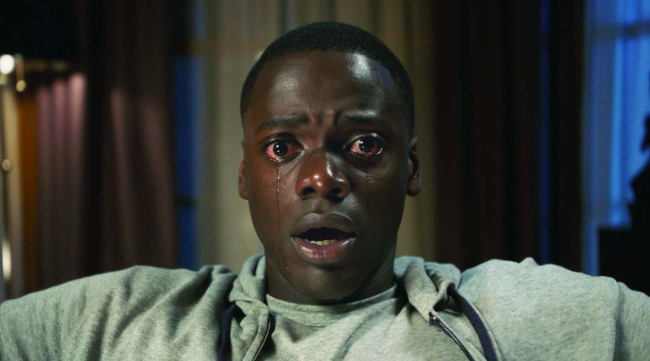
From the fantasy of eternal youth in Get Out, the desire for upward mobility in Us, to the consuming ambition and appeal to be under the spotlight in Nope, Jordan Peele uses the darkest traits of human psychology. The filmmaker’s monsters are rooted in our vices and flaws, and often have a human appearance. The director gives an important part of his narrative to the traumas and psychology of the characters. In Get Out, Rose’s mother hypnotizes Chris after he tells her the story of his mother’s death. As a result, the following scenes give a prominent place to the unconscious, thinning down the line between dream and reality.
In Us, the opening scene is a flashback to Adelaide’s childhood. The woman has been psychotic and depressed since she met a mysterious little girl on a fairground ride. In Nope, the character of Ricky (Steven Yeun), the director of the western theme park Jupiter’s Claim, is haunted by a traumatic memory of something he experienced on set as a star child. In each one of his films, Jordan Peele pays particular attention to the ghosts haunting his characters and invites us to a journey through the architecture of the human psyche.
Playing with signs and symbols
Among coincidences and images with mysterious meanings, like the white and brown rabbits kept in a cage in Us, Jordan Peele’s works put a strong emphasis on symbols. For instance, he uses quotes from the Old Testament with cryptic references as prophecies predicting future events. Us opens with a verse from Jeremiah 11:11: “I will bring on them a disaster they cannot escape. Although they cry out to me, I will not listen to them”. His latest film, Nope, starts with a quote from Nahum 3:6: “I will cast abominable filth upon you, make you vile, and make you a spectacle.” Giving an almost mystical side to the two plots, those quotes summon a form of fatality that the characters will try to thwart. Oscillating between tragedy and fantasy, Jordan Peele also strives for the creation of heavy atmospheres, where every detail is used as a manifestation of how the unexplained arises. A flock of birds on the seashore foresees a bad omen. A mysterious wind that rises on the plains of the ranch precedes the arrival of an unidentified force. Nothing is left to chance. Everything has been foreseen through signs.
Debunking the white gaze
How could one define the approach of the master of horror? In a word, political. The history of American cinema is marked by the omnipresence of the Western gaze, or white gaze, and the marginalization of the black experience, which is often presented as a stereotype when it happens to be on-screen. Hollywood’s first commercial success was the 1915 film The Birth of a Nation by American director David Ward Griffith. Released forty years after the Civil War, it glorified the segregation era and the rise of the Ku Klux Klan. By focusing on the daily lives of middle-class African Americans, Jordan Peele takes a stand against the invisibility at work that has permeated the entire history of American cinema and wants to “trivialize black faces in pop culture.” According to the American director, it is essential to create new myths, to integrate black figures into folk stories (Us), to rehabilitate the history of black cowboys, and to magnify a rebellion against a terrible, invisible force (Nope). The future of American horror cinema is at stake and Jordan Peele called upon talented actors, such as Daniel Kaluuya, Lupita Nyong’o, or Keke Palmer, to help him.